Design and Simulation of a 16 Bit Ultra Low Power SAR ADC with Digital Calibration Using 180 nm CMOS
Objective
This paper offers a comprehensive guide to low-power successive approximation register (SAR) analog-to-digital converters (ADCs). It delves into the operational principles, error analysis, and practical design considerations for these devices. Additionally, the paper provides an extensive review of cutting-edge low-power techniques applied to each component within the SAR ADC architecture, encompassing comparators, capacitive digital-to-analog converters (DACs), and SAR logic circuits
Abstract
This paper offers a comprehensive guide to low-power successive approximation register (SAR) analog-to-digital converters (ADCs). It delves into the operational principles, error analysis, and practical design considerations for these devices. Additionally, the paper provides an extensive review of cutting-edge low-power techniques applied to each component within the SAR ADC architecture, encompassing comparators, capacitive digital-to-analog converters (DACs), and SAR logic circuits. The primary objective of this work is to serve as a valuable resource for SAR ADC designers aiming to enhance energy efficiency in low-to-medium speed applications.
The design is implemented using 250nm CMOS process technology. Simulation and verification are performed using Tanner EDA tool. The results indicate that the proposed 16-bit SAR ADC achieves the desired resolution and meets the specified performance requirements. The ADC exhibits low power consumption, and satisfactory performance. This design can find applications in various fields requiring high-precision analog-to-digital conversion, such as medical imaging, scientific instrumentation, and communication systems.
Keywords: Analog-to-digital converter (ADC), successive approximation register (SAR), low power, energy efficiencyNOTE: Without the concern of our team, please don't submit to the college. This Abstract varies based on student requirements.
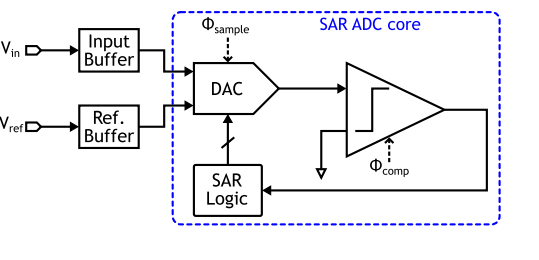
Block Diagram
Specifications
Software Requirements:
· Tool: Tanner EDA
· Technology : Ptm 250nm
Minimum Hardware Requirements:
· Microsoft Windows 7
· Intel i3 processor or equivalent
· 4GB RAM
· 100MB of available disk space
Learning Outcomes
· Basics of electronics
· VLSI design flow
· Introduction to ADC’s
· Knowledge on OP_AMP’s
· Introduction to Flash ADC
· Knowledge on SAR ADC’s
· Applications in real time
· Tanner tool implementation , schematic , simulation
· Solution providing for real time problems
· Project Development Skills:
o Problem Analysis Skills
o Problem Solving Skills
o Designing Skills
o Testing Skills
o Debugging Skills
o Presentation Skills
o Thesis Writing Skills
Demo Video


Request for Video
Related Projects
 Paper Publishing
Request Call Back
Would you like to receive a free callback now?
Choose the best time for callback:
Leave your message and we will contact you as soon as possible

6-2-85/B, Old Maternity Hospital Road, Thyagaraja Nagar, Tirupati, Andhra Pradesh – 517501
+91 9030333433
+91 9393939065
0877-2261612

Disclaimer - Takeoff Edu Group Projects are not associated or affiliated with IEEE in any way. The IEEE Projects mentioned here are mentioned in the context of student projects, whose ideas are derived from IEEE publications, not projects of or by IEEE.

