Design and Optimization of 8 bit ALU using Reversible Logic
Objective
The paper presents a design for an 8-bit ALU using reversible logic. Reversible logic is used to minimize energy dissipation during computation
Abstract
Conventional CMOS circuits dissipate energy through the loss of information bits. This energy dissipation, manifesting as power consumption, is a critical factor in low-power design. Modern digital circuits increasingly rely on Reversible Logic to address this issue. Reversible Logic minimizes heat dissipation, facilitates nearly energy-free computation, enables higher circuit densities, and enhances fault detection capabilities.
This paper introduces a novel design for a Reversible 8-bit Arithmetic Logic Unit (ALU), constructed by cascading 1-bit ALUs. Each 1-bit ALU comprises two primary components: the control unit and the adder unit. The Control Output Gate (COG) is utilized for the control unit, while the Haghparast and Navi Gate (HNG) is employed for the adder unit.
Compared to existing designs, the proposed ALU achieves a reduced gate count and transistor count, showcasing its efficiency. Moreover, the propagation delay of the proposed design is significantly lower. The design was simulated and verified using the Cadence 90nm technology software tool, affirming its effectiveness and practicality.
Keywords: Reversible logic, ALU (Arithmetic and Logic Unit), power dissipation, garbage output, COG gate, HNG gateNOTE: Without the concern of our team, please don't submit to the college. This Abstract varies based on student requirements.
Block Diagram
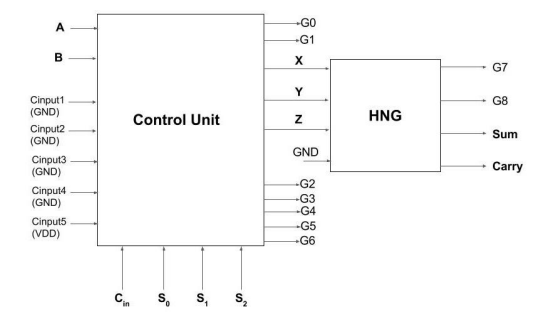
Specifications
Specifications:
Software Requirements:
• Tool: Cadence virtuoso
• Technology: 90nm
Hardware Requirements:
• Microsoft® Windows XP
• Intel® Pentium® 4 processor or Pentium 4 equivalent with SSE support
• 512 MB RAM
• 100 MB of available disk space
Learning Outcomes
Learning Outcomes:
• Basics of Digital Electronics
• Reversible Logic Gates
• Introduction to Cadence virtuoso
• ALU importance
• Rea time applications
Project Development Skills:
o Problem Analysis Skills
o Problem Solving Skills
o Logical Skills
o Designing Skills


 Paper Publishing

Request Call Back
Would you like to receive a free callback now?
Choose the best time for callback:
Leave your message and we will contact you as soon as possible

6-2-85/B, Old Maternity Hospital Road, Thyagaraja Nagar, Tirupati, Andhra Pradesh – 517501
+91 9030333433
+91 9393939065
0877-2261612

Disclaimer - Takeoff Edu Group Projects are not associated or affiliated with IEEE in any way. The IEEE Projects mentioned here are mentioned in the context of student projects, whose ideas are derived from IEEE publications, not projects of or by IEEE.

