Design and Implementation of Synchronous Dual Port Memory
Objective
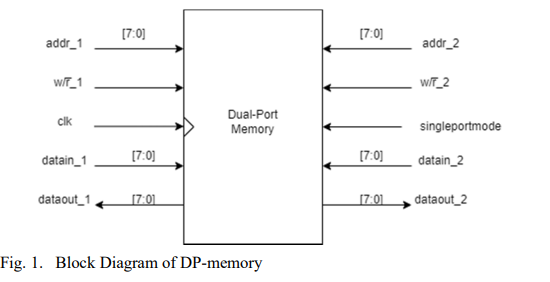
The objective of designing and implementing synchronous dual-port memory involves creating a specialized memory architecture that enables simultaneous read/write operations from two independent ports while maintaining data consistency and timing synchronization.
Abstract
This paper presents the design and implementation of a dual-port Random Access Memory (RAM) module, emphasizing versatility, simplicity, and efficiency in digital systems. The dual-port RAM facilitates simultaneous read and write operations, enabling multiple data sources to access memory concurrently while maintaining data integrity. Designed in Verilog Hardware Description Language (HDL) and synthesized on Field-Programmable Gate Array (FPGA) platforms, the module integrates priority-based conflict resolution and a port locking mechanism for single-port mode. This ensures reliable operation under various scenarios, guaranteeing efficiency and consistency in both single-port and dual-port configurations. The proposed solution offers significant advantages for designers in need of high-speed, dependable memory subsystems, particularly for real-time signal processing and multi-channel data applications. This dual-port RAM module provides the flexibility and efficiency needed for diverse application requirements, making it a valuable component in modern digital designs.
NOTE: Without the concern of our team, please don't submit to the college. This Abstract varies based on student requirements.
Block Diagram
Specifications
Software Requirements:
· Xilinx VIVADO.
Learning Outcomes
- Basics of Digital Electronics
- VLSI design Flow
- Introduction to Verilog Coding
- Different modeling styles in Verilog
o Data Flow modeling
o Structural modeling
o Behavioral modeling
o Mixed level modeling
- Introduction to Arithmetic circuits
- Applications in real time
· Xilinx ISE 14.7/Xilinx Vivado for design and simulation
· Generation of Netlist
· Solution providing for real time problems
· Project Development Skills:
o Problem Analysis Skills
o Problem Solving Skills
o Logical Skills
o Designing Skills
o Testing Skills
o Debugging Skills
o Presentation Skills


 Paper Publishing

Request Call Back
Would you like to receive a free callback now?
Choose the best time for callback:
Leave your message and we will contact you as soon as possible

6-2-85/B, Old Maternity Hospital Road, Thyagaraja Nagar, Tirupati, Andhra Pradesh – 517501
+91 9030333433
+91 9393939065
0877-2261612

Disclaimer - Takeoff Edu Group Projects are not associated or affiliated with IEEE in any way. The IEEE Projects mentioned here are mentioned in the context of student projects, whose ideas are derived from IEEE publications, not projects of or by IEEE.

