Design and Implementation of SRAM for LUT and CLB Using Clocking Mechanism in Quantum-Dot Cellular Automata
Also Available Domains Arithmetic Core
Objective
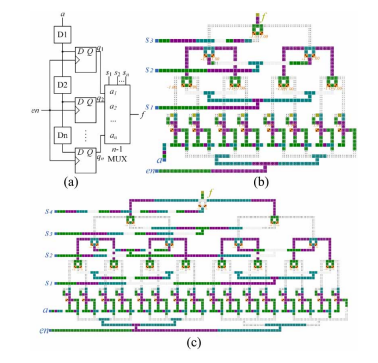
The main objective of this project is to implement n-bit architecture of SRAM through unique clocking mechanism using QCA
Abstract
Quantum-dot cellular automata (QCA) has long been deemed to be an alternative or supplementary to complementary metal oxide semiconductor (CMOS) technology in theory in the future. In general, QCA works indispensably through a four-phase clocking mechanism. However, previous works on QCA circuits mainly use the clocking to enable the synchronization of signals. In this brief, a static random access memory (SRAM) is proposed for the first time by making use of the phase difference between adjacent clock zones of the unique clocking mechanism. The SRAM saves the address decoders and thus reduces the hardware cost. A look-up table (LUT) is then built through the SRAM to achieve a significant reduction in hardware cost. To verify the practicability of these circuits proposed above, a configurable logic block (CLB) in Xilinx’s XC4000 field-programmable gate array as an example is designed. Simulation results using QCA Designer-E show that the proposed circuits have correct functions and advantages in area, cell count, delay, cost, and energy dissipation compared with previous designs. Note that these circuits are easy to be extended to 16-bit, 32-bit, or higher bit. It is worth mentioning that the comprehensive performance analyses are carried out using the QCA Designer tool
NOTE: Without the concern of our team, please don't submit to the college. This Abstract varies based on student requirements.
Block Diagram
Specifications
Specifications:
Software Requirements:
· QCA Designer tool.
· HDL: Verilog.
Hardware Requirements:
o Microsoft® Windows XP.
o Intel® Pentium® 4 processor or Pentium 4 equivalent with SSE support.
o 512 MB RAM.
o 100 MB of available disk space.
Learning Outcomes
- Basics of Digital Electronics
- VLSI design Flow
- Introduction to Quantum dot cellular automata (QCA)
- Introduction to Combinational circuits.
- Knowledge on SRAM.
- Knowledge on LUT.
- Concept on CLB.
- Concept on design and simulation tool.
- Applications in real time.
· Solution providing for real time problems
· Project Development Skills:
o Problem Analysis Skills
o Problem Solving Skills
o Logical Skills
o Designing Skills
o Testing Skills
o Debugging Skills
o Presentation Skills
o Thesis Writing Skills


 Paper Publishing

Request Call Back
Would you like to receive a free callback now?
Choose the best time for callback:
Leave your message and we will contact you as soon as possible

6-2-85/B, Old Maternity Hospital Road, Thyagaraja Nagar, Tirupati, Andhra Pradesh – 517501
+91 9030333433
+91 9393939065
0877-2261612

Disclaimer - Takeoff Edu Group Projects are not associated or affiliated with IEEE in any way. The IEEE Projects mentioned here are mentioned in the context of student projects, whose ideas are derived from IEEE publications, not projects of or by IEEE.

