Design And Implementation Of Power Efficient Multiplier Using Reversible Logic
Objective
Reduce Power Dissipation • Use reversible logic to lower energy loss, since reversible gates ideally avoid bit erasure and thus reduce heat / power dissipation. • Target ultra-low power, which is especially relevant in future VLSI, quantum, or nanocomputing contexts.
Abstract
NOTE: Without the concern of our team, please don't submit to the college. This Abstract varies based on student requirements.
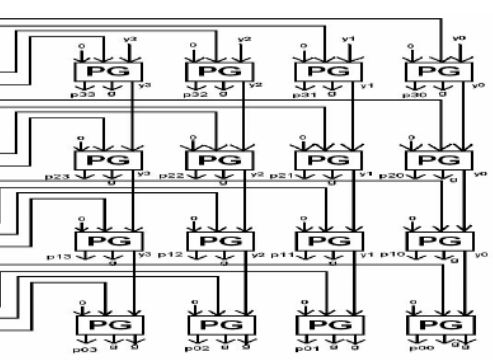
Block Diagram
Specifications
Specifications:
Software Requirements:
· Xilinx ISE14.7 Suite/Vivado2018.3 Tool.
· HDL: Verilog.
Hardware Requirements:
· Microsoft® Windows XP.
· Intel® Pentium® 4 processor or Pentium 4 equivalent with SSE support.
· 512 MB RAM.
100 MB of available disk spaceLearning Outcomes
Learning Outcomes:
• Basics of Digital Electronics
• FPGA design Flow
• Introduction to Verilog Coding
• Different modeling styles in Verilog
o Data Flow modeling
o Structural modeling
o Behavioral modeling
o Mixed level modeling
• Drawbacks of existing methods
• Applications in real time
• Xilinx ISE 14.7/Xilinx Vivado for design and simulation
• Generation of Netlist
• Solution providing for real time problems
• Project Development Skills:
o Problem Analysis Skills
o Problem Solving Skills
o Logical Skills
o Designing Skills
o Testing Skills.
o Debugging Skills.
o Presentation Skills.
o Thesis Writing Skills


Related Projects
 Paper Publishing

Request Call Back
Would you like to receive a free callback now?
Choose the best time for callback:
Leave your message and we will contact you as soon as possible

6-2-85/B, Old Maternity Hospital Road, Thyagaraja Nagar, Tirupati, Andhra Pradesh – 517501
+91 9030333433
+91 9393939065
0877-2261612

Disclaimer - Takeoff Edu Group Projects are not associated or affiliated with IEEE in any way. The IEEE Projects mentioned here are mentioned in the context of student projects, whose ideas are derived from IEEE publications, not projects of or by IEEE.

