Design and Implementation of IoT based Energy Efficient Smart Metering System for Domestic Applications
Objective
The main objective of this project is to enable monitoring of energy consumption for optimal energy usage
Abstract
The aim of this project is to develop a new energy meter which can communicate with our phones so customers can know the units consumed time-to-time, bill amount need to pay and also gives warning if the energy consumed per month crossed our predetermined value. This can simply call a smart energy meter and to develop this we need a Arduino and ESP32 microcontroller, sensors, Wi-Fi module with internet connection to communicate with the phone and Blynk platform to monitor units consumed and push warnings in mobile. This can simply be termed as Internet of Things (IoT). This smart energy meter also helps the electricity department to initiate prepaid recharges for the number of energy units to be used and can also initiate auto cut off power supply to the home when there are no units left in the account and the customer should recharge again to get supply back to home. This can make customers more control on their consumption and the energy can be saved and the global environment is saved.
Keywords: Current sensor, IOT, GSM
NOTE: Without the concern of our team, please don't submit to the college. This Abstract varies based on student requirements.
Block Diagram
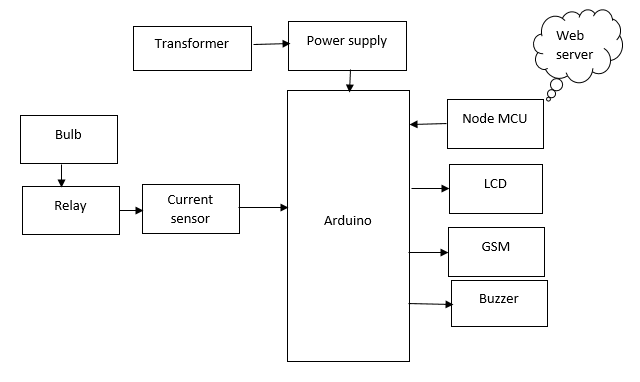
Specifications
Hardware Requirements:
- Arduino uno
- Node MCU
- LCD
- Current sensor
- Buzzer
- GSM
- Power supply
- Transformer
Software Requirements:
- Arduino IDE
- Embedded C
Learning Outcomes
- Arduino pin diagram and architecture
- How to install Arduino IDE software
- Setting up and installation procedure for Arduino
- Introduction to Arduino IDE
- Basic coding in Arduino IDE
- Working of current sensor motor driver
- Interface current sensor with Arduino
- Working of buzzer
- Interfacing buzzer module with Arduino
- Working of power supply
- About Project Development Life Cycle:
- Planning and Requirement Gathering (software’s, Tools, Hardware components, etc.,)
- Schematic preparation
- Code development and debugging
- Hardware development and debugging
- Development of the Project and Output testing
- Practical exposure to:
- Hardware and software tools.
- Solution providing for real time problems.
- Working with team/ individual.
- Work on Creative ideas.
- Project development Skills
- Problem analyzing skills
- Problem solving skills
- Creativity and imaginary skills
- Programming skills
- Deployment
- Testing skills
- Debugging skills
- Project presentation skills


 Paper Publishing

Request Call Back
Would you like to receive a free callback now?
Choose the best time for callback:
Leave your message and we will contact you as soon as possible

6-2-85/B, Old Maternity Hospital Road, Thyagaraja Nagar, Tirupati, Andhra Pradesh – 517501
+91 9030333433
+91 9393939065
0877-2261612

Disclaimer - Takeoff Edu Group Projects are not associated or affiliated with IEEE in any way. The IEEE Projects mentioned here are mentioned in the context of student projects, whose ideas are derived from IEEE publications, not projects of or by IEEE.

