Design and Implementation of a Smart Electric Fence Built on Solar with an Automatic Irrigation System
Objective
The objective of this project is to develop and deploy a Smart Electric Fence powered by solar energy, equipped with an automatic irrigation system, to provide effective security against intruders while simultaneously ensuring sustainable irrigation for enhanced land management and resource utilization
Abstract
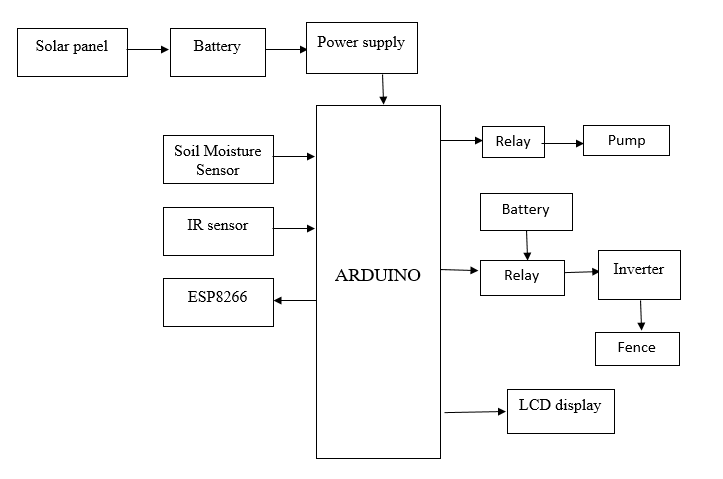
The project titled "Design and Implementation of a Smart Electric Fence with Solar-Powered Automatic Irrigation System" presents a comprehensive and sustainable solution for agricultural and livestock management. Leveraging an array of cutting-edge components, including the Arduino microcontroller, soil moisture sensor, IR sensor for animal detection, ESP8266 for WiFi connectivity, and solar panels, this system combines the benefits of security and irrigation automation. The smart electric fence is equipped with an IR sensor that detects the presence of animals, triggering the fence's electrification to deter intruders effectively. Furthermore, the system integrates solar panels to power both the fence and an automatic irrigation system, ensuring eco-friendly and self-sustaining operation.
The incorporation of IOT capabilities through the ESP8266 module enables remote monitoring and control of the electric fence and irrigation system. Users can receive updates on fence integrity, animal presence, and soil moisture levels via WIFI connectivity. The automatic irrigation system optimizes water usage by irrigating the fields based on soil moisture data, contributing to efficient and resource-conscious agriculture. This project embodies the convergence of renewable energy, automation, and smart technology, offering an eco-friendly and intelligent solution for modern agriculture and livestock management.
Keywords: Smart electric fence, Automatic irrigation, ESP8266, Arduino, Liquid Crystal Display.
NOTE: Without the concern of our team, please don't submit to the college. This Abstract varies based on student requirements.
Block Diagram
Specifications
Hardware components:
- Arduino
- Solar panel
- Power supply
- Battery
- Soil moisture sensor
- ESP8266
- IR sensor
- Pump
- Relay
- Inverter
- Fence
Software components:
- Arduino IDE
- Embedded C
Learning Outcomes
- Introduction to Microcontroller
- Microcontroller pin diagram and architecture
- Basic Coding
- Introduction to Embedded Software
- Interfacing LCD with microcontroller
- Working of power supply
- Working of rectifier
- About Project Development Life Cycle
- Planning and Requirement Gathering (software’s, Tools, Hardware components, etc.,)
- Schematic preparation
- Code development and debugging
- Hardware development and debugging
- Development of the Project and Output testing
- Practical exposure to
- Hardware and software tools.
- Solution providing for real time problems.
- Working with team individual.
- Work on Creative ideas.
- Project development Skills
- Problem analyzing skills
- Problem solving skills
- Creativity and imaginary skills
- Programming skills
- Deployment
- Testing skills
- Debugging skills
- Project presentation skills


 Paper Publishing

Request Call Back
Would you like to receive a free callback now?
Choose the best time for callback:
Leave your message and we will contact you as soon as possible

6-2-85/B, Old Maternity Hospital Road, Thyagaraja Nagar, Tirupati, Andhra Pradesh – 517501
+91 9030333433
+91 9393939065
0877-2261612

Disclaimer - Takeoff Edu Group Projects are not associated or affiliated with IEEE in any way. The IEEE Projects mentioned here are mentioned in the context of student projects, whose ideas are derived from IEEE publications, not projects of or by IEEE.

