Design and Implementation of a Google Assistant Home Automation System
Objective
The main objective of this project is to design and implement a home automation system that integrates with Google Assistant, enabling voice-controlled management of various devices like bulb and cpu fan
Abstract
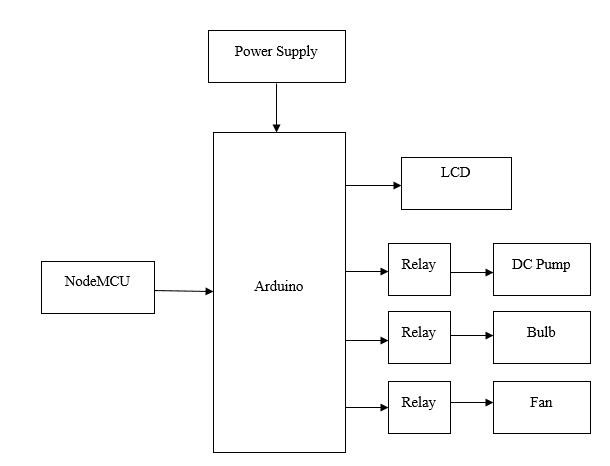
This project explores the integration of Arduino, NodeMCU, and relays to create a smart home automation system controlled by voice commands via Google Assistant and Home Assistant. The system is designed to operate three different appliances individually: a bulb, a CPU fan, and a pump. The voice commands are transmitted via the internet to a NodeMCU, which processes the commands and communicates with an Arduino to trigger the corresponding relays, ultimately controlling the appliances. The core of this system lies in the use of voice commands as the user interface. Google Assistant serves as the voice recognition platform, enabling users to control their home appliances effortlessly(since it is a prototype only one load will able to control using voice command remaining loads will be controlled using buttons). When a user issues a voice command, it is sent to the internet, where it reaches the NodeMCU. The NodeMCU, equipped with Wi-Fi connectivity, receives the command and processes it for further action. This process ensures that users can control their appliances from virtually anywhere, making the system both versatile and convenient.
The NodeMCU plays a pivotal role as the bridge between the voice command and the hardware. Upon receiving the command, the NodeMCU triggers the Arduino, which is responsible for managing the relays. Each relay corresponds to a specific appliance, allowing for individual control. For example, if a user says, "Turn on the bulb," the NodeMCU will interpret this command and activate the relssay connected to the bulb, illuminating the room. Similarly, commands like "Start the CPU fan" or "Activate the pump" will trigger the corresponding relays, enabling users to regulate their devices effortlessly.
Keywords: Arduin, NodeMCU, Google Assistant, Relay, Pump, CPU fan.
NOTE: Without the concern of our team, please don't submit to the college. This Abstract varies based on student requirements.
Block Diagram
Specifications
Hardware Requirements:
- Arduino
- NodeMCU
- Relay
- CPU fan
- Buzzer
- Bulb
- LCD
- Power Supply
- Buzzer
- LCD
Software Requirements:
- Arduino IDE
- Embedded C
Learning Outcomes
- Arduino pin diagram and architecture
- How to install Arduino IDE software
- Setting up and installation procedure for Arduino
- Introduction to Arduino IDE
- Basic coding in Arduino IDE
- Working of LCD
- Interface LCD with Arduino
- Working of power supply
- About Project Development Life Cycle
- Planning and Requirement Gathering (software’s, Tools, Hardware components, etc.,)
- Schematic preparation
- Code development and debugging
- Hardware development and debugging
- Development of the Project and Output testing
- Practical exposure to
- Hardware and software tools.
- Solution providing for real time problems.
- Working with team individual.
- Work on Creative ideas.
- Project development Skills
- Problem analyzing skills
- Problem solving skills
- Creativity and imaginary skills
- Programming skills
- Deployment
- Testing skills
- Debugging skills
- Project presentation skills


 Paper Publishing

Request Call Back
Would you like to receive a free callback now?
Choose the best time for callback:
Leave your message and we will contact you as soon as possible

6-2-85/B, Old Maternity Hospital Road, Thyagaraja Nagar, Tirupati, Andhra Pradesh – 517501
+91 9030333433
+91 9393939065
0877-2261612

Disclaimer - Takeoff Edu Group Projects are not associated or affiliated with IEEE in any way. The IEEE Projects mentioned here are mentioned in the context of student projects, whose ideas are derived from IEEE publications, not projects of or by IEEE.

