Design and Analysis Performance of IOT-Based Water Quality Monitoring System using LoRa Technology
Objective
The main objective of this project is to design and analyze the performance of an IoT-based water quality monitoring system using LoRa technology, enabling real-time data collection and assessment of water quality parameters to ensure the safety and sustainability of water resources.
Abstract
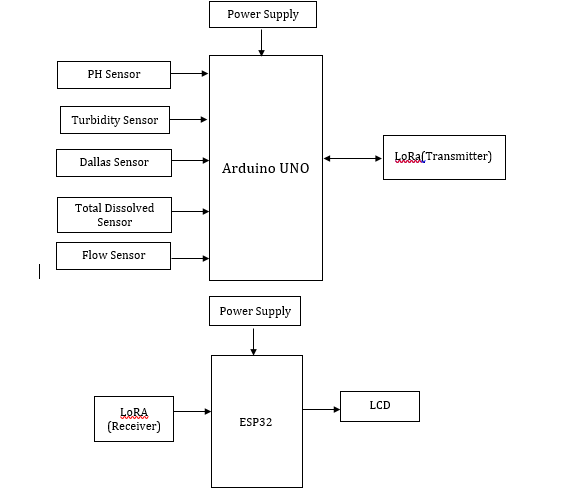
The growing concern over water quality and the need for monitoring in remote or challenging environments have driven the development of advanced monitoring systems. This project presents the design and performance analysis of an IoT-Based Water Quality Monitoring System utilizing Long-Range (LoRa) technology. The system's transmitter side is equipped with an array of sensors, including pH, turbidity, and Dallas temperature, Total Dissolved Solids (TDS), and air quality sensors. These sensors gather water quality and environmental data which is collected by an Arduino microcontroller and transmitted via a LoRa module. On the receiver side, another LoRa module receives the data, which is then relayed to an ESP32 microcontroller. The ESP32 is responsible for uploading the data to a server, in this case, Thingspeak, for remote monitoring. An LCD display is also incorporated to present immediate sensor readings.
The IoT-Based Water Quality Monitoring System provides a powerful tool for continuous water quality assessment. The LoRa technology enables long-range data transmission, making it ideal for monitoring in remote locations. This project discusses the system's design, sensor integration, and the mechanisms for data transmission and remote data visualization. Performance analysis includes an evaluation of transmission range, and system reliability. This innovative system has broad applications in environmental monitoring, ensuring the availability of data for efficient water quality management, research, and decision-making. The study also addresses the challenges and potential for further improvement, contributing to the advancement of IoT-based water quality monitoring.
Keywords: Arduino, ESP32, LoRa technology, Turbidity Sensor, Water Quality Monitoring System
NOTE: Without the concern of our team, please don't submit to the college. This Abstract varies based on student requirements.
Block Diagram
Specifications
Hardware Components:
- Arduino
- ESP32
- PH Sensor
- Level Sensor
- Turbidity Sensor
- Dallas Sensor
- Totally Disoolved Sensor
- Air Quality Sensor
- LoRa(receiver)
- LoRa(Transmitter)
- LCD
Software Components:
- Arduino IDE
- Embedded C
Learning Outcomes
- Arduino pin diagram and architecture
- How to install Arduino IDE software
- Setting up and installation procedure for Arduino
- Introduction to Arduino IDE
- Basic coding in Arduino IDE
- Working of LCD
- Interface LCD with Arduino
- Working of power supply
- About Project Development Life Cycle:
- Planning and Requirement Gathering (software’s, Tools, Hardware components, etc.,)
- Schematic preparation
- Code development and debugging
- Hardware development and debugging
- Development of the Project and Output testing
- Practical exposure to:
- Hardware and software tools.
- Solution providing for real time problems.
- Working with team/ individual.
- Work on Creative ideas.
- Project development Skills
- Problem analyzing skills
- Problem solving skills
- Creativity and imaginary skills
- Programming skills
- Deployment
- Testing skills
- Debugging skills
- Project presentation skills


 Paper Publishing

Request Call Back
Would you like to receive a free callback now?
Choose the best time for callback:
Leave your message and we will contact you as soon as possible

6-2-85/B, Old Maternity Hospital Road, Thyagaraja Nagar, Tirupati, Andhra Pradesh – 517501
+91 9030333433
+91 9393939065
0877-2261612

Disclaimer - Takeoff Edu Group Projects are not associated or affiliated with IEEE in any way. The IEEE Projects mentioned here are mentioned in the context of student projects, whose ideas are derived from IEEE publications, not projects of or by IEEE.

