Design and Analysis of Grid-Interactive DFIG Based WECS for Regulated Power Flow
Also Available Domains Power Quality
Objective
Main objective of this project is sharing of reactive power at below-rated wind speeds, which essentially reduces the amount of rotor winding copper loss and maintaining the unity power at stator terminals.
Abstract
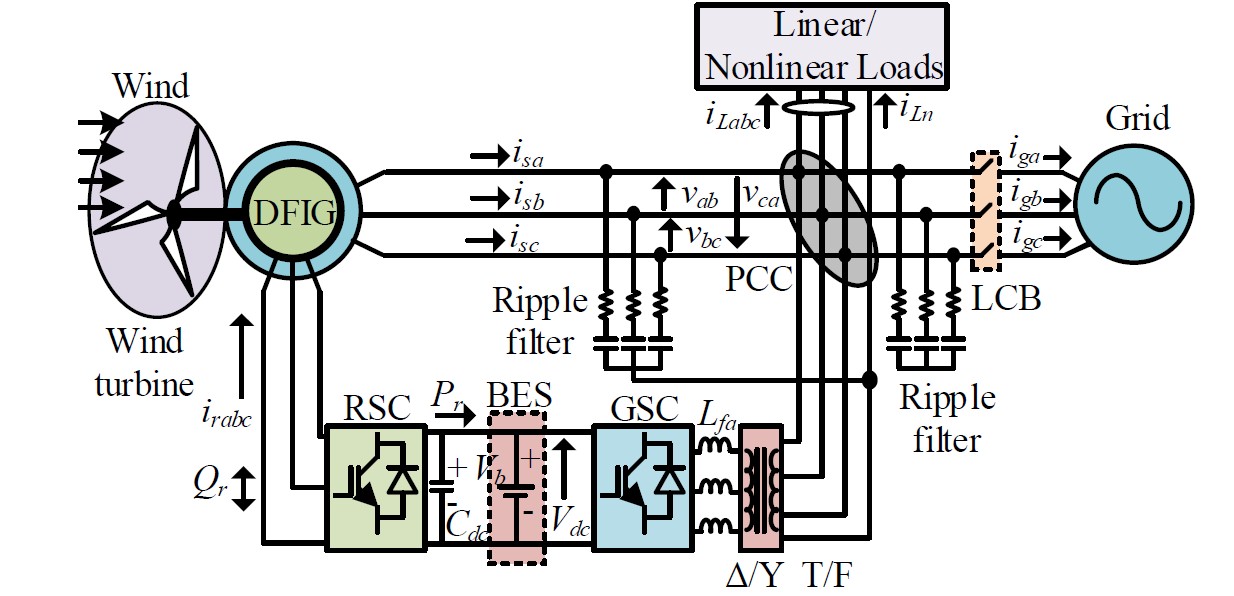
This project will present the sharing of reactive power between two converters of a Doubly Fed Induction Generator (DFIG) based wind energy conversion system interacting with the grid. The Rotor Side Converter (RSC) control of DFIG is designed for sharing of reactive power at below rated wind speeds, which essentially reduces the amount of rotor winding copper loss. However, at rated wind speed, the RSC control is designed to maintain the unity power factor at stator terminals and to extract rated power without exceeding its rating. Further, the reduction in rotor winding copper loss due to reactive power distribution is demonstrated with an example.
Moreover, the Grid Side Converter (GSC) control is designed to feed regulated power flow to the grid along with reactive power support to DFIG and to the load connected at point of common coupling. Moreover, the GSC control is designed to compensate load unbalance and load harmonics.
The battery energy storage connected at DC link of back-to-back converters, is used for maintaining the regulated grid power flow regardless of wind speed variation. The system is modelled and its performance is simulated under change in grid reference active power, varying wind speed, sharing of reactive power and unbalanced nonlinear load using Simpower Systems toolbox of MATLAB.
Keywords: DFIG, reactive power sharing, flux-oriented control, regulated power flow, wind energy conversion system, battery energy storage, power quality.
NOTE: Without the concern of our team, please don't submit to the college. This Abstract varies based on student requirements.
Block Diagram
Specifications
Software Configuration:
Operating System : Windows 7/8/10
Application Software : Matlab/Simulink
Hardware Configuration:
RAM : 8 GB / 4 GB (Min)
Processor : I3 / I5(Mostly prefer)
Learning Outcomes
- Introduction to Matlab/Simulink
- What is EISPACK & LINPACK
- How to start with MATLAB
- About Matlab language
- About tools & libraries
- Application of Matlab/Simulink
- About Matlab desktop
- Features of Matlab/Simulink
- Basics on Matlab/Simulink
- Introduction to wind power generation.
- Introduction to MPPT controllers.
- Design of power converters.
- Design of Voltage source converter.
- Design of battery energy storage system.
- Design of MPPT controller.
- Design o PLL.
- Design of BESS.
- Design of wind turbine.
- Design of DFIG.
- Design of hysteresis band current controller (HBCC).
- We can learn about the generation of gate pulses to the converter.
- We can learn about the differences between Linear and nonlinear loads.
- We can learn about different types of PWM techniques .
- Introduction to controllers.
- Design of PI controller.
- Introduction to open loop and closed loop control system.
- How battery works ?
- We can learn about the Clarke’s transformation.
- We can learn about the park’s transformation.
- Project Development Skills:
- Problem analyzing skills
- Problem solving skills
- Creativity and imaginary skills
- Programming skills
- Deployment
- Testing skills
- Debugging skills
- Project presentation skills
- Thesis writing skills
Demo Video


Request for Video
 Paper Publishing
Request Call Back
Would you like to receive a free callback now?
Choose the best time for callback:
Leave your message and we will contact you as soon as possible

6-2-85/B, Old Maternity Hospital Road, Thyagaraja Nagar, Tirupati, Andhra Pradesh – 517501
+91 9030333433
+91 9393939065
0877-2261612

Disclaimer - Takeoff Edu Group Projects are not associated or affiliated with IEEE in any way. The IEEE Projects mentioned here are mentioned in the context of student projects, whose ideas are derived from IEEE publications, not projects of or by IEEE.

