Defects Localization and Classification Method of Power Transmission Line Insulators Aerial Images
Objective
The objective of this project is to develop a deep learning-based framework for the accurate localization and classification of defects in power transmission line insulators using aerial images captured by UAVs. The primary aim is to enhance the reliability and efficiency of power grid maintenance by automating the detection and categorization of various types of insulator defects. The project leverages a combination of YOLOv8, EfficientDet, and Faster R-CNN models to overcome the limitations of existing methods, particularly in complex environments. By integrating these advanced models, the system aims to improve defect detection accuracy, reduce false positives, and support timely maintenance interventions for the power transmission infrastructure.
Abstract
Accurate detection, localization, and classification of defects in power transmission line insulators captured by Unmanned Aerial Vehicles (UAVs) are essential for maintaining the safety and reliability of high-voltage power grids. Traditional methods in this domain have encountered challenges in achieving robust performance, particularly in complex environmental conditions, and have primarily focused on detecting a single type of defect. To overcome these challenges, this paper presents a novel deep learning framework that combines the strengths of three state-of-the-art object detection models: YOLOv8, EfficientDet, and Faster R-CNN. The proposed approach enhances both the localization and classification of multiple insulator defects in aerial imagery. By leveraging the unique capabilities of each model, the framework improves detection accuracy, reduces false positives, and enables effective classification of various defect types, contributing to more efficient and automated maintenance strategies for power transmission infrastructure. The experimental results demonstrate the effectiveness of the integrated framework in detecting and categorizing defects, outperforming existing single-model approaches.
Keywords: Power transmission line, insulators, UAV, defect localization, defect classification, YOLOv8, EfficientDet, Faster R-CNN, deep learning, aerial images, object detection.
NOTE: Without the concern of our team, please don't submit to the college. This Abstract varies based on student requirements.
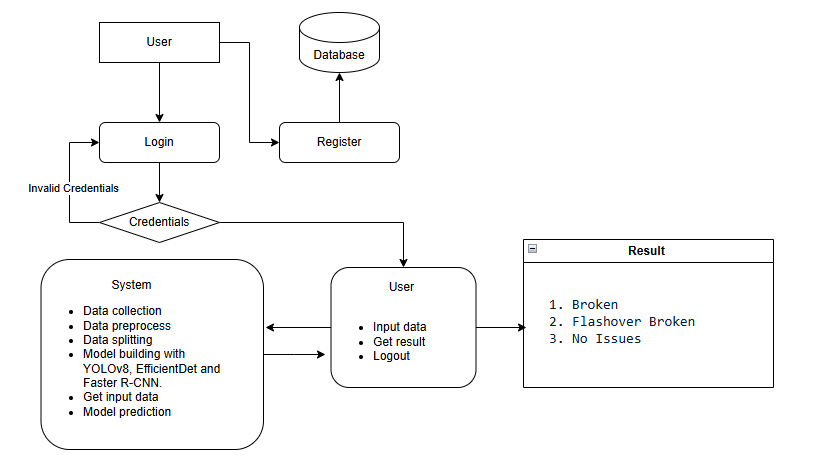
Block Diagram
Specifications
Hardware Requirements
Processor - I3/Intel Processor
Hard Disk - 160GB
Key Board - Standard Windows Keyboard
Mouse - Two or Three Button Mouse
Monitor - SVGA
RAM - 8GB
Software Requirements:
Operating System : Windows 7/8/10
Server side Script : HTML, CSS, Bootstrap & JS
Programming Language : Python
Libraries : Django, Pandas, Numpy, Tensorflow, Scikit-learn.
IDE/Workbench : VS Code
Technology : Python 3.10
Database : SQLite

Demo Video


Request for Video
 Paper Publishing
Request Call Back
Would you like to receive a free callback now?
Choose the best time for callback:
Leave your message and we will contact you as soon as possible

6-2-85/B, Old Maternity Hospital Road, Thyagaraja Nagar, Tirupati, Andhra Pradesh – 517501
+91 9030333433
+91 9393939065
0877-2261612

Disclaimer - Takeoff Edu Group Projects are not associated or affiliated with IEEE in any way. The IEEE Projects mentioned here are mentioned in the context of student projects, whose ideas are derived from IEEE publications, not projects of or by IEEE.

