Deep Learning Frameworks for Real-Time Passenger Detection and Tracking
Objective
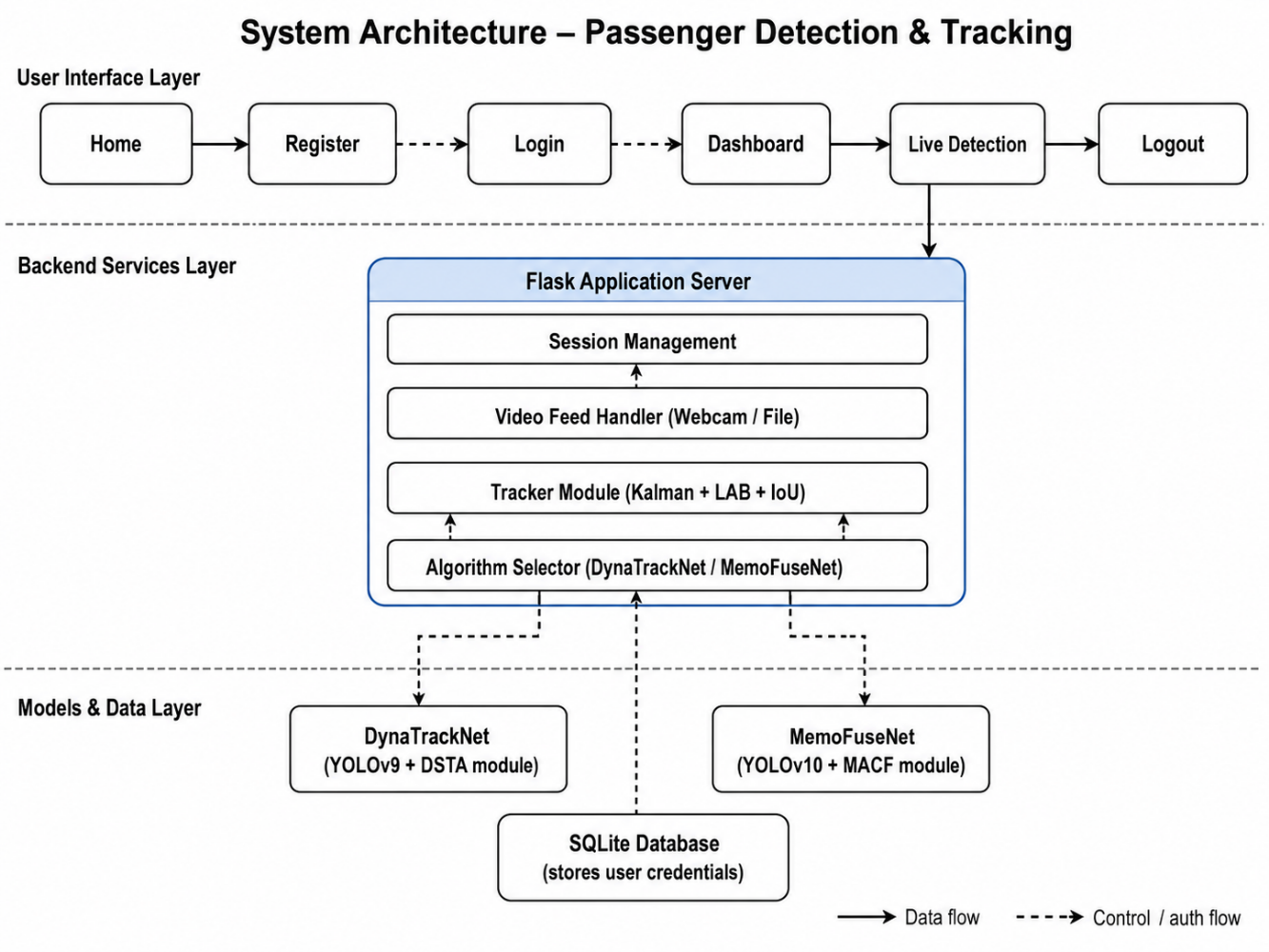
The objective of this system is to provide a secure, web-based platform that enables users to register, log in, and interact with live passenger tracking using two deep learning models, DynaTrackNet and MemoFuseNet. The platform integrates data collection, preprocessing, model training, and evaluation with real-time video streaming, allowing users to switch tracking algorithms on-the-fly, visualize bounding boxes and trajectories, and analyze performance metrics such as accuracy, identity consistency, and inference speed.
Abstract
This research develops and evaluates two deep learning frameworks—DynaTrackNet and MemoFuseNet—for detecting and tracking passengers in crowded visual environments. A complete web-based platform is constructed using HTML, CSS, JavaScript for the front-end, and Python with the Flask framework for the back-end. SQLite serves as the database for user management. The system includes five functional modules: Home, Register, Login, Dashboard, Live Detection, and Logout. DynaTrackNet focuses on motion dynamics by predicting target positions across sequential frames, ensuring continuous tracking even under partial obstructions. MemoFuseNet employs a memory-augmented structure that stores long-term appearance features, enabling re-identification of individuals after temporary disappearance. The Crowd Detection dataset from Roboflow provides annotated images labeled with a single class Crowd to train and validate both algorithms. The platform allows users to switch between the two detection engines via an interactive dashboard and observe live detection outputs with bounding boxes and trajectory lines. Performance metrics include tracking consistency, identity switch frequency, and processing latency. Results indicate that DynaTrackNet offers smoother motion continuity, while MemoFuseNet reduces identity mismatches in dense scenarios. The system provides a controlled environment for comparative analysis of motion-based versus memory-based tracking architectures. This work contributes a modular, accessible tool for research in passenger tracking using deep learning.
NOTE: Without the concern of our team, please don't submit to the college. This Abstract varies based on student requirements.
Block Diagram
Specifications
.2 HARDWARE REQUIREMENTS
Processor - I3/Intel Processor
Hard Disk - 160GB
Key Board - Standard Windows Keyboard
Mouse - Two or Three Button Mouse
Monitor - SVGA
RAM - 8GB
5.3 SOFTWARE REQUIREMENTS:
Operating System : Windows 7/8/10
Server side Script : HTML, CSS
Programming Language : Python
Libraries : Flask, Os, pandasUltralytics, Numpy
IDE/Workbench : VsCode
Technology : Python 3.8+
Database : sqllite


 Paper Publishing

Request Call Back
Would you like to receive a free callback now?
Choose the best time for callback:
Leave your message and we will contact you as soon as possible

6-2-85/B, Old Maternity Hospital Road, Thyagaraja Nagar, Tirupati, Andhra Pradesh – 517501
+91 9030333433
+91 9393939065
0877-2261612

Disclaimer - Takeoff Edu Group Projects are not associated or affiliated with IEEE in any way. The IEEE Projects mentioned here are mentioned in the context of student projects, whose ideas are derived from IEEE publications, not projects of or by IEEE.

