Deep Learning for Real-Time Malaria Parasite Detection and Counting Using YOLO-mp
Objective
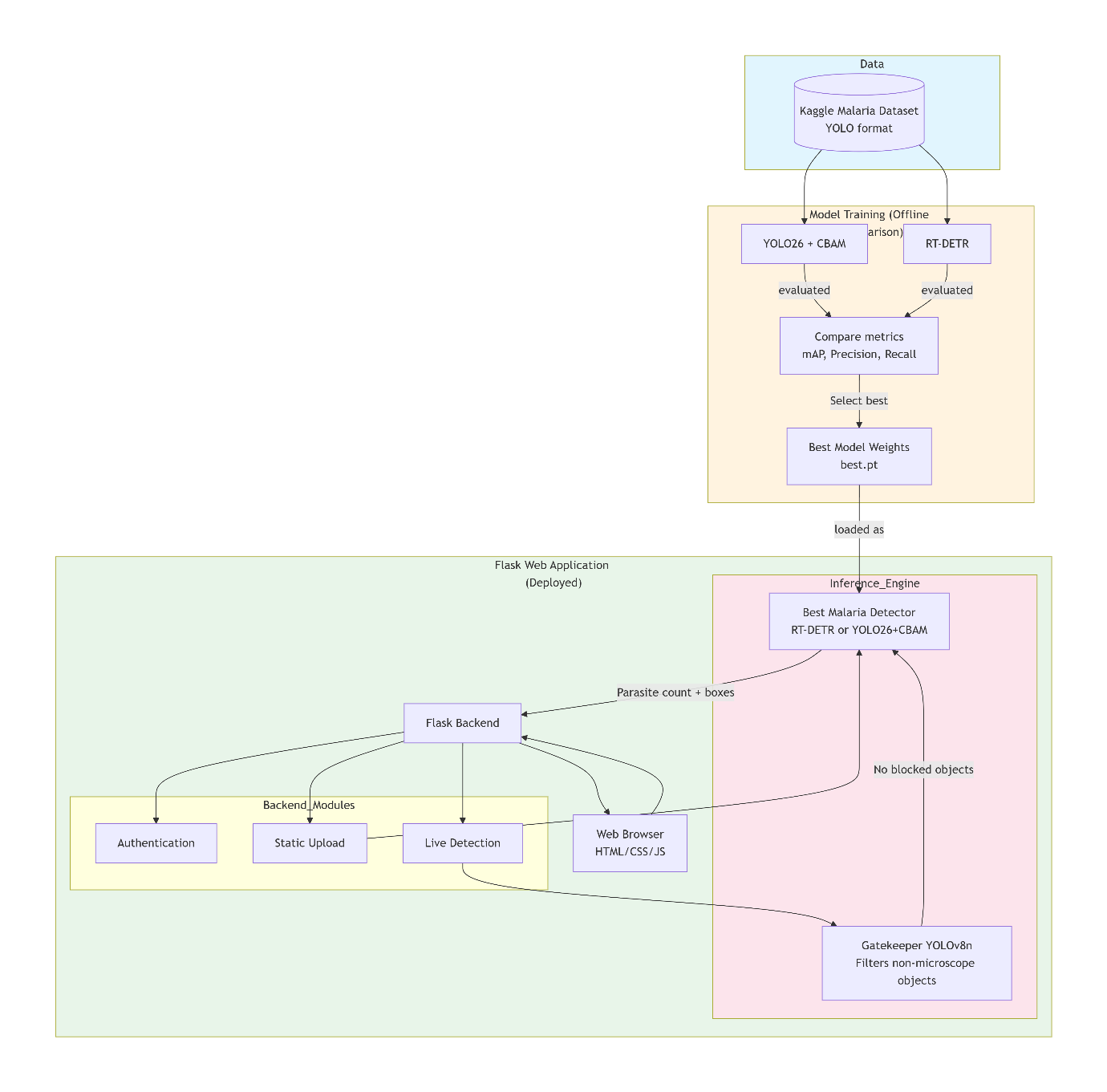
This project automates malaria parasite detection and counting from blood smear images using deep learning. Two architectures are trained on a YOLO?formatted dataset (1,693 training, 360 validation, 365 test images): YOLOv6 enhanced with CBAM and RT?DETR (transformer?based). Models are evaluated using COCO metrics (mAP, precision, recall). A Flask web application allows users to upload images, receive annotated bounding boxes, parasite counts, and clinical burden classification (negative to very high), supporting rapid and consistent diagnosis.
Abstract
Malaria remains a life‑threatening disease, and accurate quantification of Plasmodium parasites in blood smear microscopy is essential for diagnosis and treatment monitoring. This work presents a deep learning framework for automated detection and counting of malaria parasites from microscopic images. Two state‑of‑the‑art object detection architectures are independently trained and evaluated on a public YOLO‑formatted dataset containing 1,693 training, 360 validation, and 365 test images. The first model enhances YOLO26 with a Convolutional Block Attention Module (CBAM) to refine feature representations. The second employs RT‑DETR, a transformer‑based detector that eliminates non‑maximum suppression via bipartite matching. Both models undergo rigorous evaluation using COCO metrics (mAP@0.5, mAP@0.5:0.95, precision, recall). A complete web application built with Flask, HTML, CSS, and JavaScript integrates the trained models, allowing users to upload blood smear images, receive parasite counts with annotated bounding boxes, and obtain clinical burden classification (negative, low, moderate, high, very high). The system achieves robust detection performance while providing an accessible interface for malaria parasite counting, supporting clinicians in rapid and consistent assessment.
Keywords: Malaria detection, Plasmodium, YOLO26, CBAM, RT‑DETR, object detection, parasite counting, deep learning, medical image analysis, Flask web application.
NOTE: Without the concern of our team, please don't submit to the college. This Abstract varies based on student requirements.
Block Diagram
Specifications
1. SOFTWARE REQUIREMENS
Operating System : Windows 7/8/10
Server-side Script : HTML, CSS, Bootstrap & JS
Programming Language : Python
Libraries : Flask, Pandas, Sklearn,Pytorch, NumPy, Seaborn, Matplotlib,pillow, ultralytics
IDE/Workbench : VSCode
Technology : Python 3.8+
Server Deployment : Xampp Server
Database : MySQL
2. HARDWARE REQUIREMENTS
Processor - I5/Intel Processor
RAM - 8GB+ (min)
Hard Disk - 128 GB+
Key Board - Standard Windows Keyboard
Mouse - Two or Three Button Mouse
Monitor - Any


 Paper Publishing

Request Call Back
Would you like to receive a free callback now?
Choose the best time for callback:
Leave your message and we will contact you as soon as possible

6-2-85/B, Old Maternity Hospital Road, Thyagaraja Nagar, Tirupati, Andhra Pradesh – 517501
+91 9030333433
+91 9393939065
0877-2261612

Disclaimer - Takeoff Edu Group Projects are not associated or affiliated with IEEE in any way. The IEEE Projects mentioned here are mentioned in the context of student projects, whose ideas are derived from IEEE publications, not projects of or by IEEE.

