Deep Ensemble Learning with Pruning for DDoS Attack Detection in IoT Networks
Objective
The main idea of this project is to determine whether network traffic is indicative of a DDoS attack or normal
Abstract
Distributed Denial of Service (DDoS) attacks present a significant challenge to the reliability and security of IoT networks, often resulting in service disruptions, data breaches, and operational downtime. This research introduces an advanced deep ensemble learning framework for detecting DDoS attacks, enhanced with Convolutional Neural Networks (CNN) and Long Short-Term Memory (LSTM) networks. CNNs are employed to extract spatial correlations from network flow features, while LSTMs capture sequential temporal dependencies in traffic behavior, enabling accurate modeling of complex attack patterns.
The proposed framework integrates deep learning with traditional ensemble classifiers, including a Stacking Classifier (Random Forest, Gradient Boosting, Naive Bayes), a Voting Classifier (Logistic Regression, Decision Tree, KNN, AdaBoost), and a TPOT Classifier that automates pipeline optimization. Additionally, pruning techniques are applied to remove redundant or low-performing models, improving computational efficiency.
A comprehensive set of network traffic features including packet lengths, inter-arrival times, flow duration, and TCP flags are used for training. The system is evaluated using accuracy, precision, recall, and F1-score, demonstrating high detection accuracy and low false positives. The combined use of CNN, LSTM, and optimized ensembles makes the approach scalable and robust for real-time DDoS detection in IoT environments.
Keywords: DDoS detection, IoT security, CNN, LSTM, ensemble learning, TPOT, stacking, pruning, traffic analysis, network features.
NOTE: Without the concern of our team, please don't submit to the college. This Abstract varies based on student requirements.
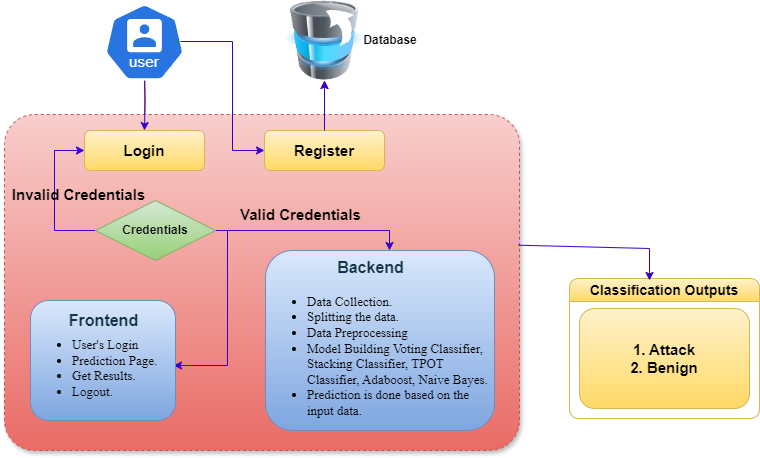
Block Diagram
Specifications
H/W Specifications:
· Processor : I5/Intel Processor
· RAM : 8GB (min)
· Hard Disk : 128 GB
S/W Specifications:
• Operating System : Windows 10
• Server-side Script : Python 3.6
• IDE : PyCharm, Jupyter notebook
• Libraries Used : Numpy, IO, OS, Flask, Keras, pandas, tensorflow

Demo Video


Request for Video
 Paper Publishing
Request Call Back
Would you like to receive a free callback now?
Choose the best time for callback:
Leave your message and we will contact you as soon as possible

6-2-85/B, Old Maternity Hospital Road, Thyagaraja Nagar, Tirupati, Andhra Pradesh – 517501
+91 9030333433
+91 9393939065
0877-2261612

Disclaimer - Takeoff Edu Group Projects are not associated or affiliated with IEEE in any way. The IEEE Projects mentioned here are mentioned in the context of student projects, whose ideas are derived from IEEE publications, not projects of or by IEEE.

