Deep Attention Fusion Framework for Automated Monkeypox Skin Image Classification
Objective
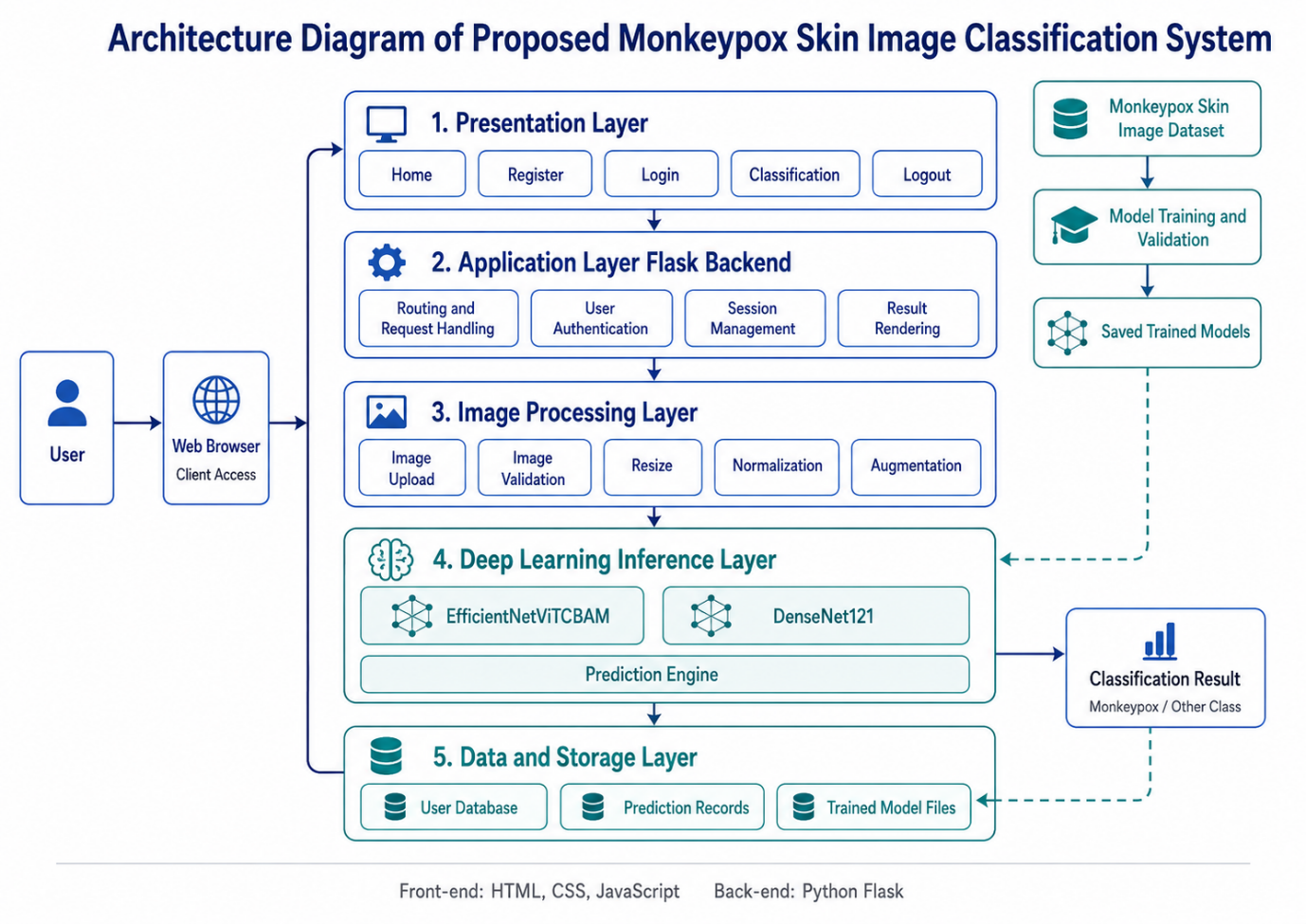
The main objective of this project is to develop a deep learning-based system for monkeypox skin image classification. The first objective is to use the Monkeypox Skin Image Dataset for training and evaluating the selected models. The second objective is to implement EfficientNetViTCBAM for advanced feature extraction and attention-based classification. This model helps the system focus on important regions in the skin image and reduce the effect of less useful background information. The third objective is to implement DenseNet121 as a comparative model to analyze classification performance. Another objective is to build a simple web application using Flask, HTML, CSS, and JavaScript, where users can register, log in, upload an image, and view the classification result. The project also aims to maintain a clear workflow through separate modules such as Home, Register, Login, Classification, and Logout. In addition, the system aims to provide a user-friendly interface and organized backend processing. Overall, the objective is to create an accurate, understandable, and research-oriented monkeypox skin image classification system using modern deep learning methods.
Abstract
Monkeypox is a viral skin-related disease that can show visible symptoms through skin lesions, rashes, and infected patches. Early identification through medical images can support faster screening and better decision-making. This project focuses on developing an automated skin image classification system using deep learning techniques. The system uses the Monkeypox Skin Image Dataset from Kaggle for training and testing the models. Two deep learning models, EfficientNetViTCBAM and DenseNet121, are applied to classify skin images accurately. It combines efficient feature extraction, vision transformer-based learning, and attention mechanisms to focus on important lesion regions. DenseNet121 is used as a strong comparative model because of its dense feature reuse and stable classification performance. The proposed system includes user-friendly modules such as Home, Register, Login, Classification, and Logout. The front end is developed using HTML, CSS, and JavaScript, while the back end is implemented using Python with the Flask framework. Users can register, log in, upload a skin image, and receive the predicted disease class through the classification module. The main aim of this work is to improve the accuracy and reliability of monkeypox image classification using advanced deep learning models. This project can be useful for academic research, medical image analysis studies, and intelligent disease screening system development.
Keywords: Monkeypox, Skin Image Classification, Deep Learning, EfficientNetViTCBAM, DenseNet121, CBAM, Vision Transformer, Flask, Medical Image Analysis, Automated ClassificationNOTE: Without the concern of our team, please don't submit to the college. This Abstract varies based on student requirements.
Block Diagram
Specifications
4.1 SOFTWARE REQUIREMENS
Operating System : Windows 7/8/10
Server side Script : HTML, CSS, Bootstrap & JS
Programming Language : Python
Libraries Flask, Pandas, Torch, Keras, Sklearn, Numpy , Seaborn
IDE/Workbench : VSCode
Server Deployment : Xampp Server
Database : MySQL
4.2 HARDWARE REQUIREMENTS
Processor - I3/Intel Processor
RAM - 8GB (min)
Hard Disk - 128 GB
Key Board - Standard Windows Keyboard
Mouse - Two or Three Button Mouse
Monitor - Any


 Paper Publishing

Request Call Back
Would you like to receive a free callback now?
Choose the best time for callback:
Leave your message and we will contact you as soon as possible

6-2-85/B, Old Maternity Hospital Road, Thyagaraja Nagar, Tirupati, Andhra Pradesh – 517501
+91 9030333433
+91 9393939065
0877-2261612

Disclaimer - Takeoff Edu Group Projects are not associated or affiliated with IEEE in any way. The IEEE Projects mentioned here are mentioned in the context of student projects, whose ideas are derived from IEEE publications, not projects of or by IEEE.

