Deep and Machine Learning-Based Detection of European Bee-Eaters Using Bird Sounds
Objective
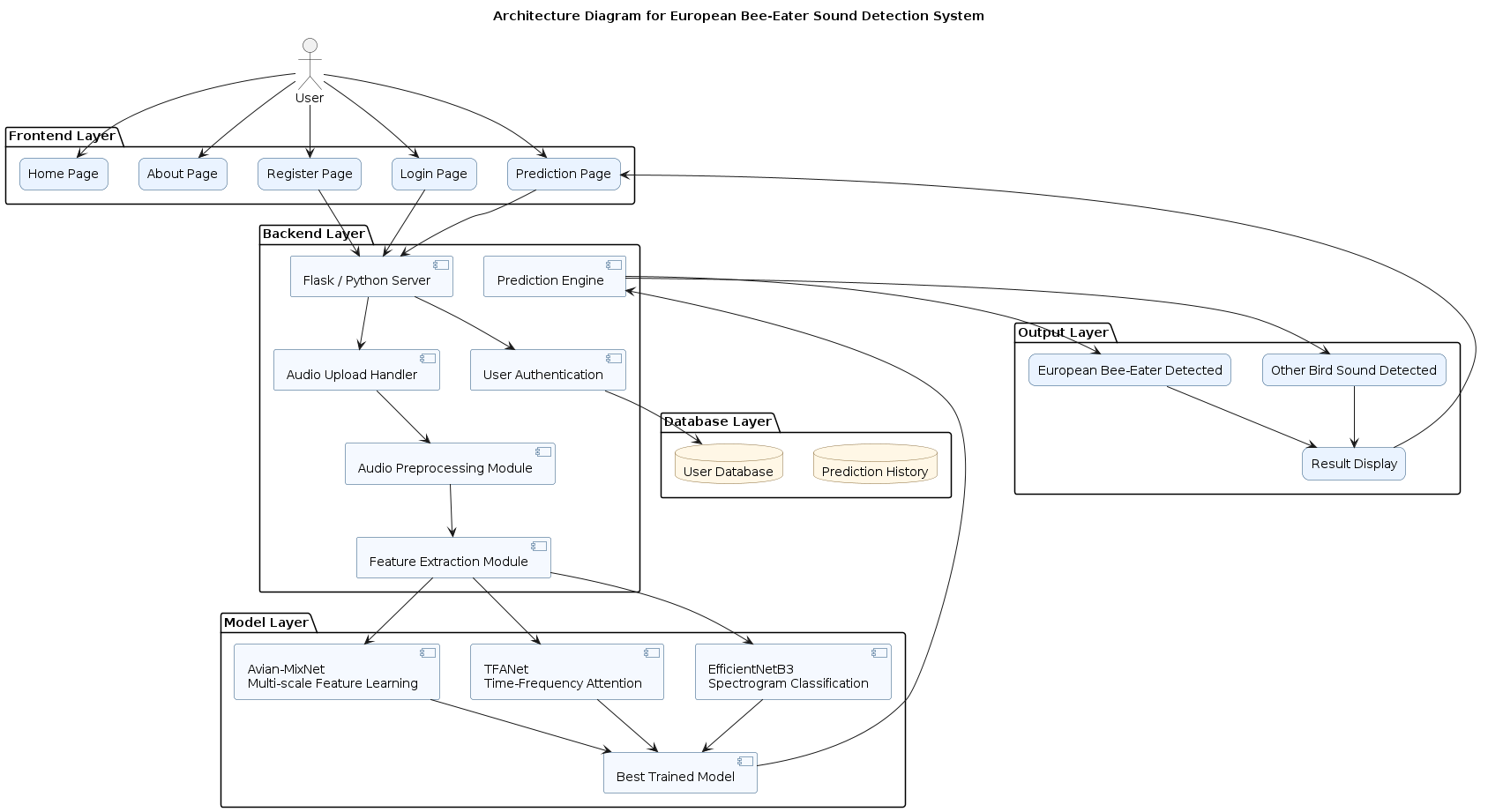
The main objective of this project is to develop an automated bird sound detection system that can identify European Bee-Eater vocalizations from audio recordings. The system uses audio preprocessing techniques to clean and standardize the input sound files before converting them into spectrogram or Mel-spectrogram images. These representations are then given to deep learning models such as Avian-MixNet, TFANet, and EfficientNetB3 for feature extraction and classification. The project aims to reduce manual effort in bird species identification and improve detection accuracy using advanced learning models. Overall, the system supports efficient bird sound analysis for ecological monitoring, biodiversity research, and automated species recognition.
Abstract
Bird sound classification plays an important role in biodiversity monitoring, species identification, and ecological observation. This study focuses on detecting European Bee-Eater vocalizations from bird audio recordings using deep learning and machine learning techniques. The BirdCLEF 2024 Additional MP3 dataset from Kaggle is used as the primary audio source for this work. The collected MP3 files are preprocessed through noise reduction, audio normalization, segmentation, and conversion into spectrogram or Mel-spectrogram representations. These transformed audio features help the models understand time-frequency patterns present in bird vocal signals. Three models are used for classification: Avian-MixNet, TFANet, and EfficientNetB3. Avian-MixNet is designed to learn multi-scale acoustic features from bird calls, while TFANet applies time-frequency attention to focus on the most informative regions of the spectrogram. EfficientNetB3 is used as an efficient convolutional neural network model for extracting deep visual features from spectrogram images. The proposed system aims to improve the accuracy and reliability of European Bee-Eater sound detection by combining audio preprocessing, feature extraction, and deep classification models. This approach can support researchers and environmental monitoring teams in identifying bird species from large audio collections with reduced manual effort. Overall, the study presents an automated and intelligent framework for bird sound-based European Bee-Eater detection.
Keywords: European Bee-Eater Detection, Bird Sound Classification, Deep Learning, Machine Learning, BirdCLEF 2024, Audio Signal Processing, Mel-Spectrogram, Avian-MixNet, TFANet, EfficientNetB3, Time-Frequency Attention, Species Identification.
NOTE: Without the concern of our team, please don't submit to the college. This Abstract varies based on student requirements.
Block Diagram
Specifications
4.1 SOFTWARE REQUIREMENS
Operating System : Windows 7/8/10
Server side Script : HTML, CSS & JS
Programming Language : Python
Libraries : NumPy, Pandas, Librosa, Matplotlib, Seaborn, Scikit-learn, TensorFlow, Keras, PyTorch, Torchaudio, OpenCV, SoundFile, SciPy, Joblib, Pickle, Flask, Streamlit, OS, Glob, Random, Tqdm.
IDE/Workbench : VSCode
Server Deployment : MYSQL
Database : MySQL
4.2 HARDWARE REQUIREMENTS
Processor - I3/Intel Processor
RAM - 8GB (min)
Hard Disk - 128 GB
Key Board - Standard Windows Keyboard
Mouse - Two or Three Button Mouse
Monitor - Any
Learning Outcomes
4.1 SOFTWARE REQUIREMENS
Operating System : Windows 7/8/10
Server side Script : HTML, CSS & JS
Programming Language : Python
Libraries : NumPy, Pandas, Librosa, Matplotlib, Seaborn, Scikit-learn, TensorFlow, Keras, PyTorch, Torchaudio, OpenCV, SoundFile, SciPy, Joblib, Pickle, Flask, Streamlit, OS, Glob, Random, Tqdm.
IDE/Workbench : VSCode
Server Deployment : MYSQL
Database : MySQL
4.2 HARDWARE REQUIREMENTS
Processor - I3/Intel Processor
RAM - 8GB (min)
Hard Disk - 128 GB
Key Board - Standard Windows Keyboard
Mouse - Two or Three Button Mouse
Monitor - Any


 Paper Publishing

Request Call Back
Would you like to receive a free callback now?
Choose the best time for callback:
Leave your message and we will contact you as soon as possible

6-2-85/B, Old Maternity Hospital Road, Thyagaraja Nagar, Tirupati, Andhra Pradesh – 517501
+91 9030333433
+91 9393939065
0877-2261612

Disclaimer - Takeoff Edu Group Projects are not associated or affiliated with IEEE in any way. The IEEE Projects mentioned here are mentioned in the context of student projects, whose ideas are derived from IEEE publications, not projects of or by IEEE.

