DeBAM: Decoder Based Approximate Multiplier for Low Power Applications
Objective
The primary goal seems to be creating a decoder-based approximate multiplier optimized for low power consumption in electronic circuits
Abstract
Approximate computing has emerged as a viable method for designing power-efficient computing systems, especially for applications that can tolerate controlled levels of error, such as image processing and data compression. These applications often have inherent resilience to inaccuracies, allowing certain levels of error without significant degradation in output quality. In this context, data path units like multipliers can be approximated to save power without compromising the essential functionality.
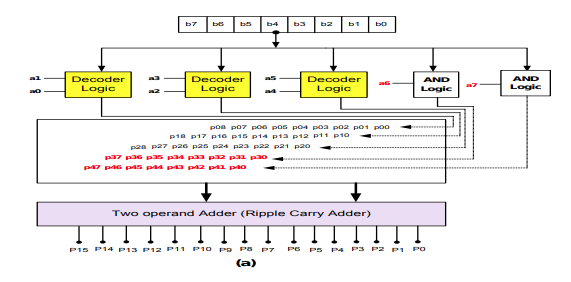
This paper proposes a novel 8-bit multiplier design based on decoder logic, which reduces the partial products generated in the computation process. By minimizing the number of partial products, the design not only lowers the hardware complexity but also substantially reduces power consumption. The proposed approximate multiplier achieves an impressive 40.96% reduction in power consumption compared to traditional, accurate multipliers, and a 22.30% reduction when compared to existing approximate multipliers. To assess the design’s effectiveness, comprehensive simulations are performed on image sharpening and data compression algorithms, chosen due to their high error tolerance. Simulation results demonstrate that the proposed multiplier maintains acceptable error levels while achieving notable power savings. Furthermore, analysis on hardware area and delay suggests that this design can offer a balanced trade-off between power efficiency, area, and computational accuracy, making it highly suitable for low-power, error-tolerant applications.
NOTE: Without the concern of our team, please don't submit to the college. This Abstract varies based on student requirements.
Block Diagram
Specifications
Software Requirements:
VIVADO 2018.3
Hardware Requirements:
· Microsoft® Windows XP
· Intel® Pentium® 4 processor or Pentium 4 equivalent with SSE support
· 512 MB RAM
· 100 MB of available disk space
Learning Outcomes
- Basics of Digital Electronics
- VLSI design Flow
- Applications in real time
· VIVADO for design and simulation
· Solution providing for real time problems
· Project Development Skills:
o Problem Analysis Skills
o Problem Solving Skills
o Logical Skills
o Designing Skills
o Testing Skills
o Debugging Skills
o Presentation Skills
o Thesis Writing Skills


 Paper Publishing

Request Call Back
Would you like to receive a free callback now?
Choose the best time for callback:
Leave your message and we will contact you as soon as possible

6-2-85/B, Old Maternity Hospital Road, Thyagaraja Nagar, Tirupati, Andhra Pradesh – 517501
+91 9030333433
+91 9393939065
0877-2261612

Disclaimer - Takeoff Edu Group Projects are not associated or affiliated with IEEE in any way. The IEEE Projects mentioned here are mentioned in the context of student projects, whose ideas are derived from IEEE publications, not projects of or by IEEE.

