DC-link Voltage Ripple Control of Regenerative CHB Drives for Capacitance Reduction
Objective
The main objective of this project is to maintain a stable low ripple dc-link voltage and also to reduce the dc-link capacitance.
Abstract
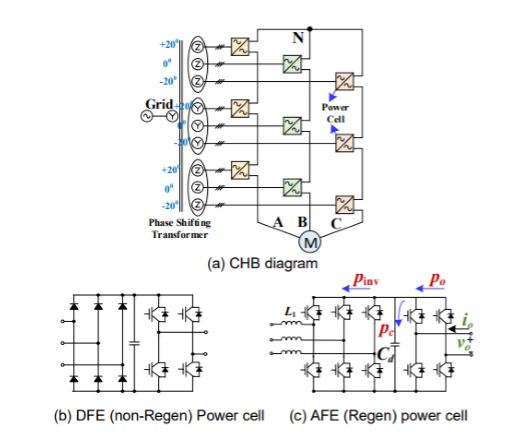
The diode-front-end (DFE) CHB inverters have prevailed in the non-regenerative industry drive domain for high-power medium-voltage applications. The regenerative version of the CHB drives is made possible by adding the extra active-front-end (AFE) rectifier in each power cell, such as a three-phase PWM rectifier.
However, due to the instantaneous power unbalance, the dc-link capacitors of the regenerative power cell need to be overdesigned to maintain a stable low ripple dc-link voltage. To reduce the dc-link capacitance, this paper proposes a novel closed-loop voltage ripple controller for the regenerative CHB drive without adding extra sensors.
In the proposed method, dc-link voltage ripple amplitude and phase angle are accurately detected with a high-performance adaptive filter. Moreover, a latent instability issue is discussed and is avoided in the proposed controller. The performance of the proposed control strategy is validated experimentally on a seven-level regenerative CHB drive.
Index Terms— Multilevel Drives, DC-Link Capacitor Reduction, Regenerative, Adaptive filtering, StabilityNOTE: Without the concern of our team, please don't submit to the college. This Abstract varies based on student requirements.
Block Diagram
Specifications
Software Configuration:
Operating System : Windows 7/8/10
Application Software : Matlab/Simulink
Hardware Configuration:
RAM : 8 GB
Processor : I3 / I5(Mostly prefer)
Learning Outcomes
- Introduction to Matlab/Simulink
- What is EISPACK & LINPACK
- How to start with MATLAB
- About Matlab language
- About tools & libraries
- Application of Matlab/Simulink
- About Matlab desktop
- Features of Matlab/Simulink
- Basics on Matlab/Simulink
- Introduction to controllers.
- Study of PWM techniques.
- Project Development Skills:
- Problem analyzing skills
- Problem solving skills
- Creativity and imaginary skills
- Programming skills
- Deployment
- Testing skills
- Debugging skills
- Project presentation skills
- Thesis writing skills


 Paper Publishing

Request Call Back
Would you like to receive a free callback now?
Choose the best time for callback:
Leave your message and we will contact you as soon as possible

6-2-85/B, Old Maternity Hospital Road, Thyagaraja Nagar, Tirupati, Andhra Pradesh – 517501
+91 9030333433
+91 9393939065
0877-2261612

Disclaimer - Takeoff Edu Group Projects are not associated or affiliated with IEEE in any way. The IEEE Projects mentioned here are mentioned in the context of student projects, whose ideas are derived from IEEE publications, not projects of or by IEEE.

