Data Integrity Audit Based on Data Blinding for Cloud and Fog Environment
Objective
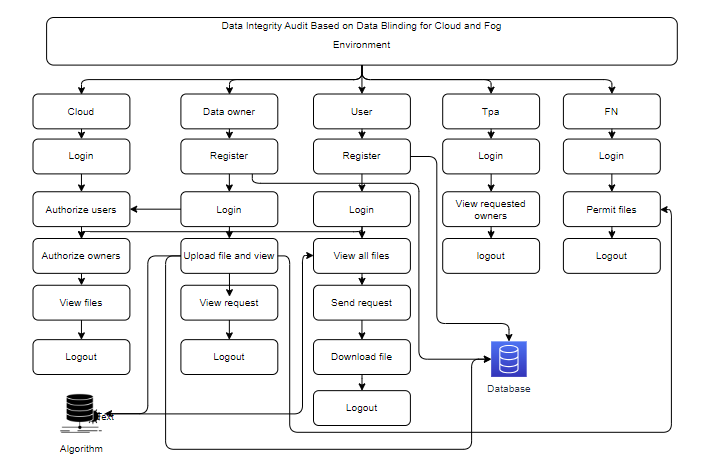
The primary objective of this project is to enhance the efficiency and security of data integrity auditing within cloud-fog computing. The key goals include implementing a novel audit scheme based on data blinding, establishing a fog computing layer to reduce transmission delays through edge devices, dynamically optimizing data paths for improved communication efficiency, and introducing a blind factor to prevent potential data leaks. Additionally, the project aims to provide a comprehensive security model and proof based on computational Diffie-Hellman assumptions, validating the effectiveness of the proposed scheme through experimental results.
Abstract
Cloud-fog computing represents a pioneering computing paradigm that extends the capabilities of traditional cloud computing by leveraging fog nodes to deliver diverse services. Conventional data integrity auditing faces challenges such as inadequate data security, sluggish data processing speeds, and suboptimal communication efficiency. To address these issues, this paper introduces a data integrity audit scheme founded on data blinding. In this approach, edge devices within the transmission node establish a fog computing layer between the cloud service provider and the data owner, mitigating transmission delays. The dynamic allocation of subordinate distribution relationships and weights among fog nodes optimizes data paths, further reducing transmission delays. Additionally, a blind factor is incorporated into the integrity audit during evidence generation to prevent potential data leaks. The paper presents a security model and security proof based on computational Diffie-Hellman (CDH) assumptions. Experimental results demonstrate that the integration of the fog computing layer and blind factor into the data integrity audit process significantly reduces data communication delays while enhancing overall data audit security.
Keywords: Cloud and fog computing, data blinding, integrity audit, cloud storage.
NOTE: Without the concern of our team, please don't submit to the college. This Abstract varies based on student requirements.
Block Diagram
Specifications
H/W CONFIGURATION:
· Processor : I3/Intel Processor
· Hard Disk : 160GB
· Key Board : Standard Windows Keyboard
· Mouse : Two or Three Button Mouse
· Monitor : SVGA
· RAM : 8GB
S/W CONFIGURATION:
· Operating System : Windows 7/8/10
· Server side Script : HTML, CSS, Bootstrap & JS
· Programming Language : Python
· Libraries : Django/flask, Pandas, Mysql.connector, Os, Smtplib, Numpy
· IDE/Workbench : PyCharm
· Technology : Python 3.6+
· Server Deployment : Xampp Server


 Paper Publishing

Request Call Back
Would you like to receive a free callback now?
Choose the best time for callback:
Leave your message and we will contact you as soon as possible

6-2-85/B, Old Maternity Hospital Road, Thyagaraja Nagar, Tirupati, Andhra Pradesh – 517501
+91 9030333433
+91 9393939065
0877-2261612

Disclaimer - Takeoff Edu Group Projects are not associated or affiliated with IEEE in any way. The IEEE Projects mentioned here are mentioned in the context of student projects, whose ideas are derived from IEEE publications, not projects of or by IEEE.

