Data Driven Classification of Opioid Patients Using Machine Learning
Objective
The project aims to develop a predictive model using machine learning and CNNs to identify high-risk opioid patients, aiding early intervention and personalized treatment planning in healthcare. It analyzes diverse data including demographics, medical histories, and social factors to uncover patterns linked to opioid dependency. Using algorithms like Decision Trees, Logistic Regression, MLP Classifier, and Stacking Classifier, alongside CNNs, it enhances predictive accuracy. The Flask-based web app facilitates seamless model deployment for healthcare providers, aiming to improve patient outcomes and support public health efforts against opioid misuse.
Abstract
The project "Data Driven Classification of Opioid Patients Using Machine Learning and CNN" aims to develop an effective predictive model for identifying high-risk opioid patients. Opioid misuse and addiction have become a critical public health issue, necessitating proactive identification and intervention strategies. The project utilizes a diverse dataset comprising demographic information, medical history, treatment details, and social support metrics. These features are crucial in understanding and predicting the likelihood of opioid dependency.
The dataset preprocessing involves standardizing numerical data and encoding categorical variables to ensure compatibility with various machine learning algorithms. Users can select from algorithms such as Decision Tree, Logistic Regression, MLP Classifier, and Stacking Classifier to train models directly through a Flask-based web application. Additionally, a Convolutional Neural Network (CNN) architecture is employed to capture intricate patterns in the data, particularly useful for complex medical datasets.
The CNN model architecture includes sequential layers with dense connections and dropout regularization, implemented using TensorFlow/Keras. This model is trained alongside traditional machine learning algorithms to compare and optimize predictive accuracy.
The outcomes of this project are twofold: firstly, to provide healthcare professionals with a reliable tool to identify patients at high risk of opioid misuse early on, allowing for timely interventions and personalized treatment plans. Secondly, to contribute to ongoing efforts in leveraging machine learning and deep learning techniques for improving public health outcomes and addressing substance use disorders effectively
Keywords: Machine Learning, Opioid Dependency, Predictive Modeling, Convolutional Neural Network, Healthcare Analytics, Substance Use Disorders, Data-driven Classification, Flask Web Application, Intervention Strategies, Public Health
NOTE: Without the concern of our team, please don't submit to the college. This Abstract varies based on student requirements.
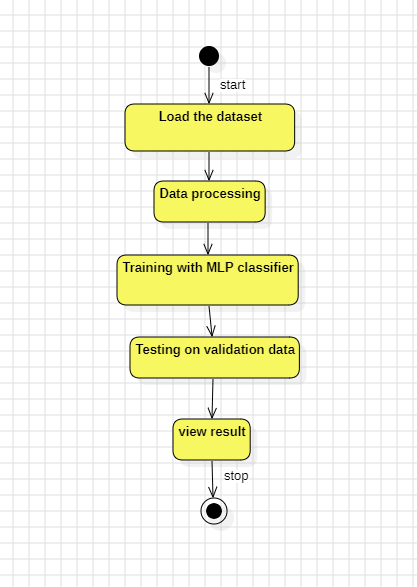
Block Diagram
Specifications
Hardware:
Operating system : Windows 7 or 7+
RAM : 8 GB
Hard disc or SSD : More than 500 GB
Processor : Intel 3rd generation or high or Ryzen with 8 GB Ram
Software:
Software’s : Python 3.10 or high version
IDE : Visual Studio Code.
Framework : Flask

Demo Video


Request for Video
 Paper Publishing
Request Call Back
Would you like to receive a free callback now?
Choose the best time for callback:
Leave your message and we will contact you as soon as possible

6-2-85/B, Old Maternity Hospital Road, Thyagaraja Nagar, Tirupati, Andhra Pradesh – 517501
+91 9030333433
+91 9393939065
0877-2261612

Disclaimer - Takeoff Edu Group Projects are not associated or affiliated with IEEE in any way. The IEEE Projects mentioned here are mentioned in the context of student projects, whose ideas are derived from IEEE publications, not projects of or by IEEE.

