Data Augmentation Based Enhancement for Efficient Network Traffic Classification
Objective
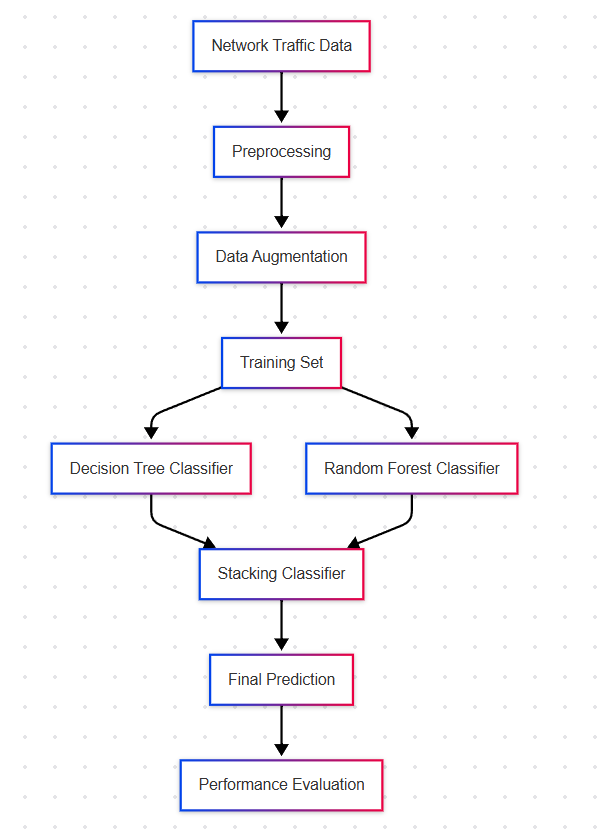
the study's goal is to enhance the practice of network traffic classification using techniques of data augmentation. The study is primarily focused on the aspect of finding the effects that synthetic data generation has on decision tree and stacking classifier classification accuracy. The study for augmented data addresses the labeling issue where there is very little data for the sometimes-labeled representations for examples of VPN and non-VPN traffic. It is further meant to show how data augmentation can add to the strength of classifiers, thereby making them more accurate and generalized in a real-world network environment, where, at certain times, data typically create their own out-of-the-box challenges.
Abstract
Network traffic classification is an important function in networking systems, but the lack of labeled data for various network conditions inhibits most of the conventional classification models. The work proposes data-augmentation enhancement for a more efficient network traffic classification. The method generates synthetic data to increase the data set, thereby promoting classifier robustness and accuracy. In particular, we analyze the working of decision trees and stacking classifiers in the context of the enhanced classification. The decision tree classifier is picked mainly due to its interpretability and faster operational training, while the stacking classifier combines several different models to benefit from the complementary strengths of the individual models. This study uses two real-world datasets for evaluation: "TimeBasedFeatures-Dataset-15s-NO-VPN" and "TimeBasedFeatures-Dataset-15s-VPN," which embodies the presence or absence of VPN usage on network traffic. From the same experiment it has been ascertained that the proposed data augmentation enhances the performance of both the classifiers of traffic pattern differentiation particularly when operating under diverse network environments. It is also evident that the proposed method can be used as potential approach to improve traffic classification with high accuracy levels and applicability to real-world scenarios.
Keywords: Network security, traffic analysis, and performance evaluation with regards to Network Traffic Classification, Data Augmentation, Decision Tree, Stacking Classifier, VPN Traffic, Time-based Features, Machine Learning.
NOTE: Without the concern of our team, please don't submit to the college. This Abstract varies based on student requirements.
Block Diagram
Specifications
4.1 SOFTWARE REQUIREMENS
Operating System : Windows 7/8/10
Server side Script : HTML, CSS, Bootstrap & JS
Programming Language : Python
Libraries :Flask, Torch, Tensorflow, Pandas, Mysql.connector
IDE/Workbench : VSCode
Server Deployment : Xampp Server
Database : MySQL
4.2 HARDWARE REQUIREMENTS
Processor - I3/Intel Processor
RAM - 8GB (min)
Hard Disk - 128 GB
Key Board - Standard Windows Keyboard
Mouse - Two or Three Button Mouse
Monitor - Any
Demo Video


Request for Video
 Paper Publishing
Request Call Back
Would you like to receive a free callback now?
Choose the best time for callback:
Leave your message and we will contact you as soon as possible

6-2-85/B, Old Maternity Hospital Road, Thyagaraja Nagar, Tirupati, Andhra Pradesh – 517501
+91 9030333433
+91 9393939065
0877-2261612

Disclaimer - Takeoff Edu Group Projects are not associated or affiliated with IEEE in any way. The IEEE Projects mentioned here are mentioned in the context of student projects, whose ideas are derived from IEEE publications, not projects of or by IEEE.

