Dam Management and Disaster Monitoring System using IoT
Objective
The objective of this project is to implement a Dam Management and Disaster Monitoring System using IoT (Internet of Things) technology, with the goal of ensuring efficient dam operation, early detection of potential disasters, and effective mitigation strategies
Abstract
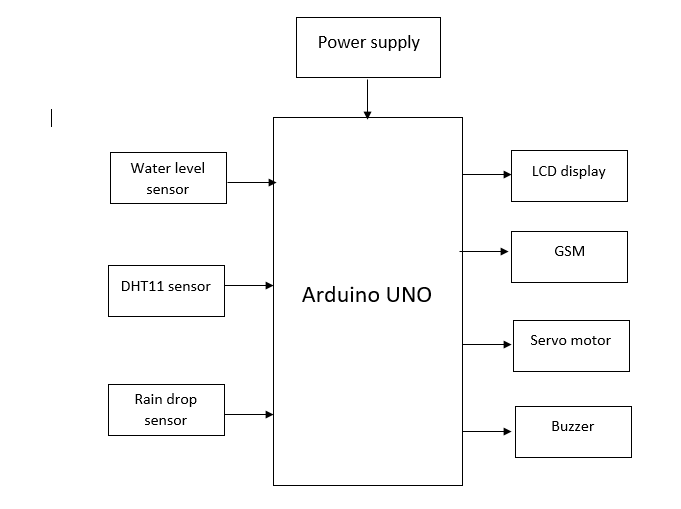
The "Dam Management and Disaster Monitoring System using IOT" project represents a cutting-edge initiative to address the critical challenges associated with dam infrastructure. It employs a sophisticated array of sensors, including water level sensors, DHT11 sensors for temperature and humidity monitoring, raindrop sensors for precipitation measurement, and GSM communication technology to create a robust IOT network. Additionally, the integration of a servo motor allows for dynamic and automated control of dam gates. This comprehensive approach enables the collection and analysis of critical data, empowering dam operators with the information needed to make proactive decisions, prevent potential disasters, optimize water resource management, and ensure the structural integrity of dams.
By combining multi-sensor data with remote monitoring and control capabilities, this project promises to significantly enhance dam safety and resilience in the face of evolving environmental conditions. It not only offers timely alerts and data insights to safeguard against disasters but also contributes to the sustainable utilization of water resources. The integration of IOT technology into dam management represents a pivotal step towards more efficient and secure infrastructure, ultimately mitigating risks and ensuring these critical structures.
Keywords:
Internet of Things, Water level monitoring, Monitoring Dams, Disaster Prevention, Alert System, Environment conditions
NOTE: Without the concern of our team, please don't submit to the college. This Abstract varies based on student requirements.
Block Diagram
Specifications
Hardware Components:
- Arduino
- Water Level sensor
- Power supply
- DHT11 sensor
- Raindrop sensor
- LCD display
- GSM
- Buzzer
- Servo Motor
Software Components:
- Arduino IDE
- Embedded C
Learning Outcomes
- Introduction to Microcontroller
- Microcontroller pin diagram and architecture
- Basic Coding
- Introduction to Embedded Software
- Interfacing LCD with microcontroller
- Working of power supply
- Working of rectifier
- About Project Development Life Cycle
- Planning and Requirement Gathering (software’s, Tools, Hardware components, etc.,)
- Schematic preparation
- Code development and debugging
- Hardware development and debugging
- Development of the Project and Output testing
- Practical exposure to
- Hardware and software tools.
- Solution providing for real time problems.
- Working with team individual.
- Work on Creative ideas.
- Project development Skills
- Problem analyzing skills
- Problem solving skills
- Creativity and imaginary skills
- Programming skills
- Deployment
- Testing skills
- Debugging skills
- Project presentation skills


 Paper Publishing

Request Call Back
Would you like to receive a free callback now?
Choose the best time for callback:
Leave your message and we will contact you as soon as possible

6-2-85/B, Old Maternity Hospital Road, Thyagaraja Nagar, Tirupati, Andhra Pradesh – 517501
+91 9030333433
+91 9393939065
0877-2261612

Disclaimer - Takeoff Edu Group Projects are not associated or affiliated with IEEE in any way. The IEEE Projects mentioned here are mentioned in the context of student projects, whose ideas are derived from IEEE publications, not projects of or by IEEE.

