Critical-Path Analysis and Low-Complexity Implementation of the LMS Adaptive Algorithm
Also Available Domains Xilinx Vivado|Xilinx ISE
Objective
This paper suggests three topologies for the LMS adaptive filter in light of these findings: There are three different designs: (i) Design 1 has no adaptation delays, (ii) Design 2 has just one adaptation delay, and (iii) Design 3 has two adaptation delays.
Abstract
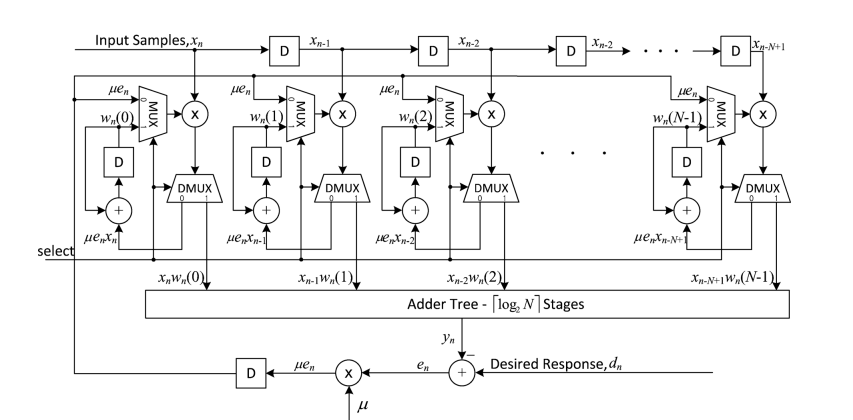
In order to derive its architectures for high-speed and low-complexity implementation, this study gives a rigorous analysis of the least-mean-square (LMS) adaptive filter's critical path. It is demonstrated that the direct-form LMS adaptive filter offers substantially faster convergence and smaller register complexity while having almost the same critical path as its transpose-form equivalent. From the critical-path evaluation, it is further demonstrated that, in most practical circumstances, no pipelining is needed to build a direct-form LMS adaptive filter. In contrast, cases where a very high sampling rate is required can be realised with a very tiny adaptation delay. This paper suggests three topologies for the LMS adaptive filter in light of these findings:
There are three different designs: (i) Design 1 has no adaptation delays, (ii) Design 2 has just one adaptation delay, and (iii) Design 3 has two adaptation delays. Design 1 utilises the smallest area and the EPS, or minimum energy per sample. The best direct-form structures now in use require 41.9% more EPS and 80.4% more area than Design 1. While offering nearly twice and three times the MUF at a cost of 55.0% and 60.6% more area, Designs 2 and 3 use a little bit more EPS than Design 1 does.
Index Terms—Adaptive filters, critical-path optimization, least mean square algorithms, LMS adaptive filter
NOTE: Without the concern of our team, please don't submit to the college. This Abstract varies based on student requirements.
Block Diagram
Specifications
Software Requirements:
· Xilinx ISE/Vivado
Hardware Requirements:
· Microsoft® Windows XP
· Intel® Pentium® 4 processor or Pentium 4 equivalent with SSE support
· 512 MB RAM
· 100 MB of available disk space
Learning Outcomes
- Basics of Digital Electronics
- VLSI design Flow
- Introduction to filters
- Writing Verilog code.
- Introduction to LMS adaptive filter.
- Knowledge on implementation of LMS adaptive filter with delays.
- Applications in real time
· Xilinx tool for writing code, synthesis and simulation
· Solution providing for real time problems
· Project Development Skills:
o Problem Analysis Skills
o Problem Solving Skills
o Logical Skills
o Designing Skills
o Testing Skills
o Debugging Skills
o Presentation Skills
o Thesis Writing Skills


 Paper Publishing

Request Call Back
Would you like to receive a free callback now?
Choose the best time for callback:
Leave your message and we will contact you as soon as possible

6-2-85/B, Old Maternity Hospital Road, Thyagaraja Nagar, Tirupati, Andhra Pradesh – 517501
+91 9030333433
+91 9393939065
0877-2261612

Disclaimer - Takeoff Edu Group Projects are not associated or affiliated with IEEE in any way. The IEEE Projects mentioned here are mentioned in the context of student projects, whose ideas are derived from IEEE publications, not projects of or by IEEE.

