Credit Scoring Prediction Using Deep Learning Models in the Financial Sector.
Also Available Domains Machine Learning
Objective
The objective of this project is to develop a robust credit scoring prediction system using deep learning models. It leverages advanced architectures such as Wide & Deep DNN, Autoencoder + DNN, and TabNet to accurately predict credit scores based on a variety of financial features. The project utilizes the dataset from Kaggle to train and evaluate these models, aiming to enhance the efficiency and reliability of credit scoring systems in the financial sector. Ultimately, it seeks to provide a more accurate, data-driven approach for assessing an individual's creditworthiness.
Abstract
This project focuses on predicting credit scores using deep learning models in the financial sector. A hybrid framework is designed by combining three powerful deep learning algorithms: Wide & Deep DNN, Autoencoder + DNN, and TabNet. These models are employed to predict the creditworthiness of individuals by analyzing various financial features. The Wide & Deep DNN model captures both low-level and high-level patterns in the data, while the Autoencoder + DNN model helps in reducing dimensionality and extracting relevant features. TabNet, a more recent model, is leveraged for its ability to handle tabular data effectively, achieving the highest accuracy of 87.2%. The dataset, sourced from Kaggle, contains comprehensive information on financial attributes, and the models are evaluated based on their prediction accuracy. A Flask-based web application is developed to facilitate user interaction, including modules for Home, Register, Login, Prediction, and Logout. The integration of these models offers a robust solution for credit scoring, ensuring efficient feature representation and enhancing prediction accuracy.
Keywords: Credit Scoring, Deep Learning, TabNet, Autoencoder, Wide & Deep DNN, Financial Sector, Flask, Kaggle Dataset
NOTE: Without the concern of our team, please don't submit to the college. This Abstract varies based on student requirements.
Block Diagram
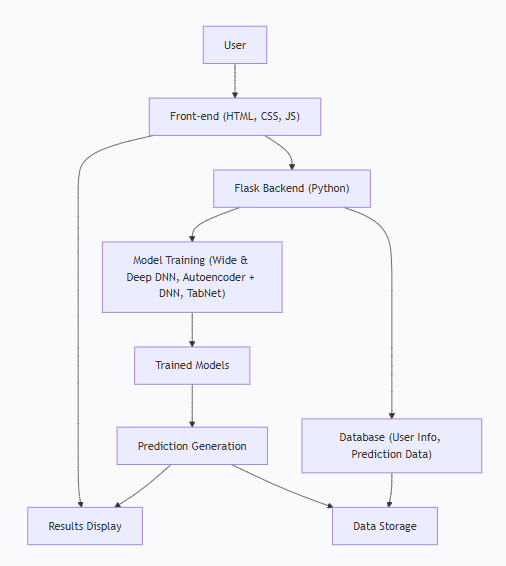
Specifications
Hardware Requirements
The hardware requirements specify the physical resources necessary to run the system effectively. For this project, the following are the recommended hardware specifications:
- Processor: Intel Core i3 or better
- Hard Disk: 160GB or higher
- Keyboard: Standard Windows Keyboard
- Mouse: Two or Three Button Mouse
- Monitor: SVGA or higher resolution
- RAM: 8GB or more
Software Requirements
The software requirements specify the environment and tools necessary to develop, run, and deploy the system. The required software components for this project are as follows:
- Operating System: Windows 7/8/10 or Linux
- Programming Language: Python
- Libraries:
- Pandas: For data manipulation and analysis.
- Numpy: For numerical operations and handling multidimensional arrays.
- scikit-learn: For machine learning algorithms and evaluation metrics.
- PyTorch: For deep learning model development and training.
- IDE/Workbench: Visual Studio Code, Jupyter Notebooks, or PyCharm for development.


 Paper Publishing

Request Call Back
Would you like to receive a free callback now?
Choose the best time for callback:
Leave your message and we will contact you as soon as possible

6-2-85/B, Old Maternity Hospital Road, Thyagaraja Nagar, Tirupati, Andhra Pradesh – 517501
+91 9030333433
+91 9393939065
0877-2261612

Disclaimer - Takeoff Edu Group Projects are not associated or affiliated with IEEE in any way. The IEEE Projects mentioned here are mentioned in the context of student projects, whose ideas are derived from IEEE publications, not projects of or by IEEE.

