Credit Card Fraud Detection Using Deep Neural Networks with Autoencoders and SMOTE Techniques
Objective
This project focuses on developing an advanced fraud detection system for credit card transactions using deep neural networks. Autoencoders are used to identify anomalies by learning normal transaction patterns, while SMOTE (Synthetic Minority Over-sampling Technique) is applied to handle class imbalance in the dataset. The system improves detection accuracy of fraudulent activities, reduces false positives, and enhances financial security by enabling real-time fraud identification.
Abstract
This project aims to detect credit card fraud using deep neural networks (DNN) combined with Autoencoders and Synthetic Minority Over-sampling Technique (SMOTE). Credit card fraud detection is a critical challenge due to the large and imbalanced nature of transactional datasets, where fraudulent transactions are much fewer than legitimate ones. The system leverages a combination of DNN models, including Feedforward Neural Networks (FNN), Convolutional Neural Networks (CNN), Recurrent Neural Network (RNN), XGBoost, and Random Forest classifiers, to classify transactions as either fraudulent or non-fraudulent. Autoencoders are employed to detect outliers or anomalies in the data, which represent fraudulent activities. SMOTE is applied to address class imbalance by generating synthetic samples of the minority class (fraudulent transactions), improving the model's ability to detect fraud. The project is implemented using a Flask web framework, where users can upload transaction data for prediction and view model performance metrics. The system provides a robust and scalable solution for credit card fraud detection, leveraging machine learning and deep learning techniques to achieve high accuracy, precision, and recall. The user-friendly interface allows for easy deployment in real-time fraud detection applications.
Keywords: Credit Card Fraud Detection, Deep Neural Networks, Autoencoders, SMOTE, Anomaly Detection, Flask, XGBoost, Random Forest, CNN, FNN, RNN, Imbalanced Data, Machine Learning, Predictive Analytics.
NOTE: Without the concern of our team, please don't submit to the college. This Abstract varies based on student requirements.
Block Diagram
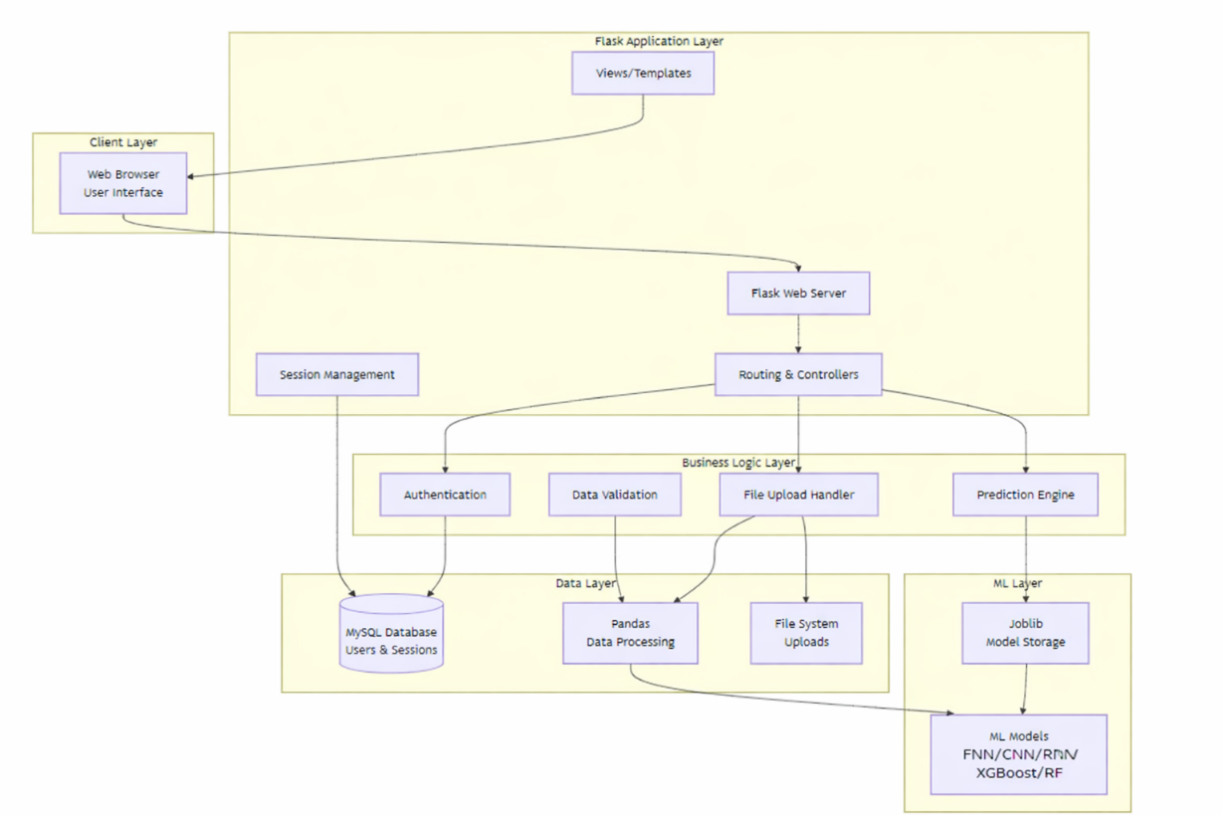
Specifications
SOFTWARE REQUIREMENS
Operating System : Windows 7/8/10
Server side Script : Flask
Programming Language : Python
Libraries : Flask, Tensorflow, Pandas, Torch, Keras, Sklearn, Numpy , Seaborn
IDE/Workbench : VSCode
Server Deployment : Xampp Server
Database : mysql
HARDWARE REQUIREMENTS
Processor - I3/Intel Processor
RAM - 8GB (min)
Hard Disk - 128 GB
Key Board - Standard Windows Keyboard
Mouse - Two or Three Button Mouse
Monitor - Any


 Paper Publishing

Request Call Back
Would you like to receive a free callback now?
Choose the best time for callback:
Leave your message and we will contact you as soon as possible

6-2-85/B, Old Maternity Hospital Road, Thyagaraja Nagar, Tirupati, Andhra Pradesh – 517501
+91 9030333433
+91 9393939065
0877-2261612

Disclaimer - Takeoff Edu Group Projects are not associated or affiliated with IEEE in any way. The IEEE Projects mentioned here are mentioned in the context of student projects, whose ideas are derived from IEEE publications, not projects of or by IEEE.

