Coordinated Fuzzy-Based Low-Voltage Ride-Through Control for PMSG Wind Turbines and Energy Storage Systems
Also Available Domains Wind Power Generation
Objective
Main objective of this project is to enhance the LVRT response and improve the stability of the system. And also effectively avoid the stability problem due to inappropriate control gains of a WT and an ESS for dc-link voltage regulation.
Abstract
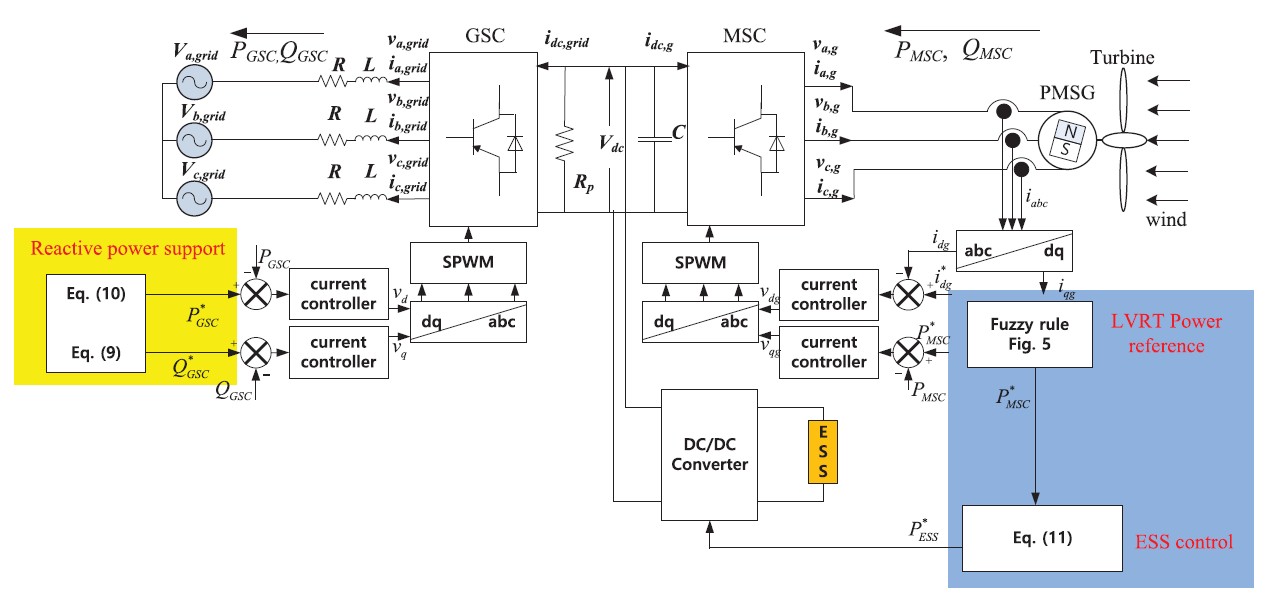
In this project, to meet several objectives, such as smoothing wind power (WP) fluctuations, shaving peaks, enabling power scheduling, allowing low-voltage ride-through (LVRT), Coordinated control methods involving a wind turbine (WT) and an energy storage system (ESS) is proposed. LVRT requirement is defined by grid operators, and it should be satisfied whenever grid faults occur. Several methodologies have been proposed for the LVRT both with or without the use of an ESS. Furthermore, using an ESS is more advantageous for several WP applications. By using an ESS, WTs can be operated in a more economic and reliable way.
However, the installation cost of an ESS is high and it has operation range constraints for charging and discharging. Moreover, the WT operation condition and ESS state-of-charge (SoC) can be different when a grid fault occurs. Therefore, it is necessary to coordinate both units, WT and ESS, for reliable and economic operation during a grid fault.
Thus, we propose a coordinated fuzzy-based LVRT method that considers the different operation conditions of a WT and an ESS. From the proposed method, the effective reference powers of a WT and an ESS are evaluated by considering the rotor speed and SoC in the fuzzy control algorithm. The effectiveness of the proposed method is validated by considering two case studies on ESS SoC and WT rotor speed violations.
Keywords: Coordinated controller, DC link regulation, energy storage system, fuzzy-logic controller, inertial response, low-voltage ride-through, rotor speed violation.
NOTE: Without the concern of our team, please don't submit to the college. This Abstract varies based on student requirements.
Block Diagram
Specifications
Software Configuration:
Operating System : Windows 7/8/10
Application Software : Matlab/Simulink
Hardware Configuration:
RAM : 8 GB / 4 GB (Min)
Processor : I3 / I5(Mostly prefer)
Learning Outcomes
- Introduction to Matlab/Simulink
- What is EISPACK & LINPACK
- How to start with MATLAB
- About Matlab language
- About tools & libraries
- Application of Matlab/Simulink
- About Matlab desktop
- Features of Matlab/Simulink
- Basics on Matlab/Simulink
- Introduction to wind power generation.
- Introduction to Matlab/Simulink software.
- Introduction to motors.
- Design of power converters.
- Design of Voltage source converter.
- Design of battery energy storage system.
- Design o PLL.
- Design of ESS.
- Design of wind turbine.
- Design of PMSM.
- Design of DC/DC converter.
- What is LVRT ?
- How to improve LVRT.
- Design of simpower systems tool boxes.
- Design of simulink tool boxes.
- We can learn about the generation of gate pulses to the converter.
- We can learn about different types of PWM techniques .
- Introduction to controllers.
- Design of PI controller.
- Design of fuzzy controller.
- Introduction to open loop and closed loop control system.
- We can learn about the Clarke’s transformation.
- We can learn about the park’s transformation.
- Project Development Skills:
- Problem analyzing skills
- Problem solving skills
- Creativity and imaginary skills
- Programming skills
- Deployment
- Testing skills
- Debugging skills
- Project presentation skills
- Thesis writing skills
Demo Video


Request for Video
 Paper Publishing
Request Call Back
Would you like to receive a free callback now?
Choose the best time for callback:
Leave your message and we will contact you as soon as possible

6-2-85/B, Old Maternity Hospital Road, Thyagaraja Nagar, Tirupati, Andhra Pradesh – 517501
+91 9030333433
+91 9393939065
0877-2261612

Disclaimer - Takeoff Edu Group Projects are not associated or affiliated with IEEE in any way. The IEEE Projects mentioned here are mentioned in the context of student projects, whose ideas are derived from IEEE publications, not projects of or by IEEE.

