Contrastive Learning-Driven Representation and Feature Selection for Spinal Fracture Detection on CT Images
Objective
The objective of this project is to develop an automated system for detecting spinal fractures from CT images using deep learning techniques. By extracting local and global anatomical features, the system aims to accurately classify images as fractured or normal. It leverages advanced convolutional and residual neural network architectures to learn meaningful representations, reduce overfitting, and improve prediction reliability. The goal is to assist medical professionals in faster and more accurate diagnosis, enhancing patient care while minimizing manual inspection effort.
Abstract
Abstract:
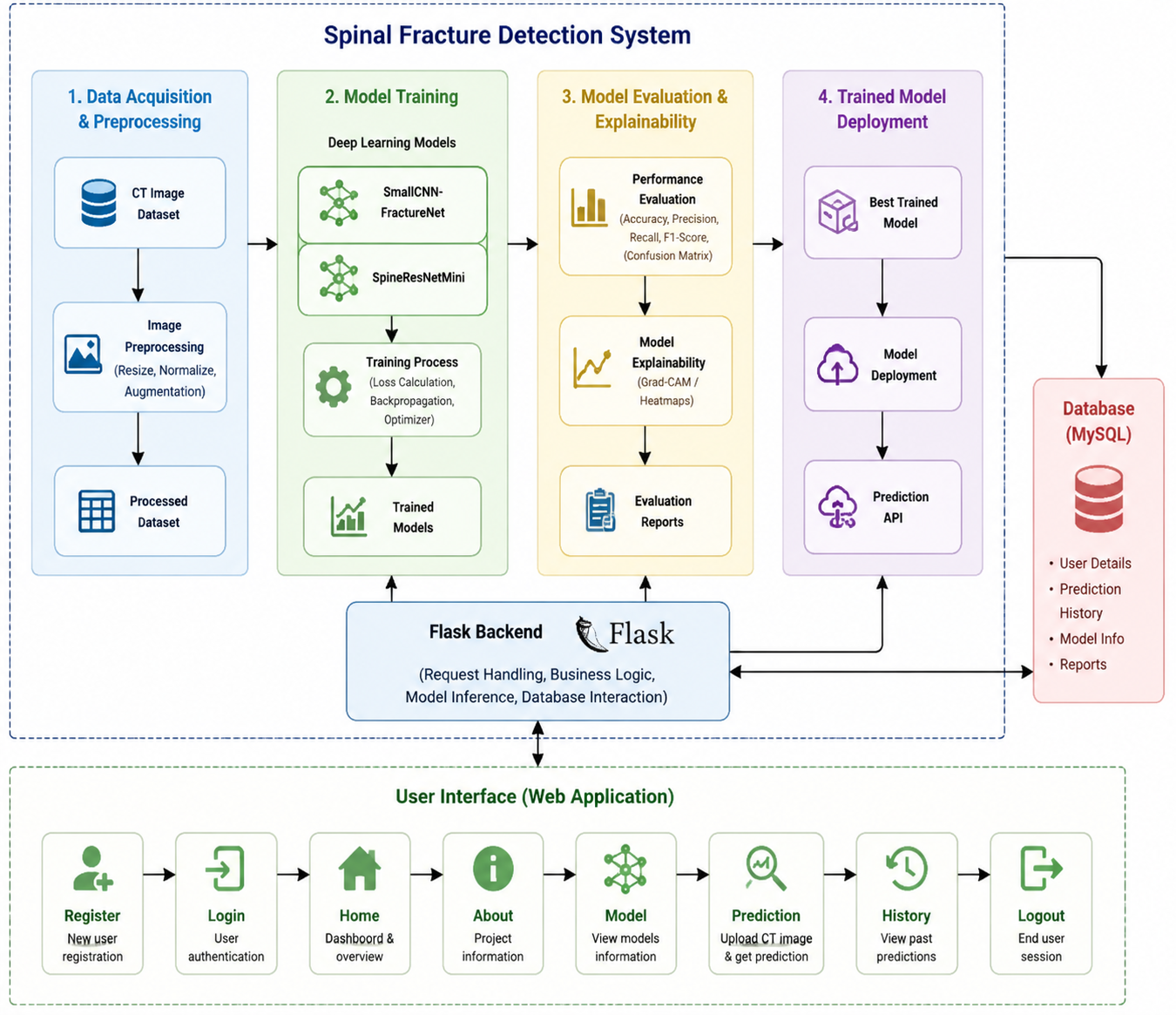
Spinal fractures are critical injuries that require prompt and accurate diagnosis to prevent long-term complications. Traditional diagnostic approaches rely heavily on manual analysis of CT images, which can be time-consuming and prone to human error. This project proposes a deep learning-based framework for automated spinal fracture detection using CT images. Two novel architectures, SmallCNN-FractureNet and SpineResNetMini, are developed to extract both local and global anatomical features, enhancing fracture detection accuracy. The dataset consists of labelled CT images of normal and fractured spines, which are preprocessed and augmented to improve model generalization. SmallCNN-FractureNet leverages a lightweight CNN to capture essential vertebral patterns, while SpineResNetMini uses residual connections to extract hierarchical features efficiently. Both models are trained with supervised learning using cross-entropy loss and optimized with Adam optimizer and cosine annealing scheduler. Evaluation metrics include accuracy, classification report, and confusion matrices, ensuring a robust assessment of model performance. The framework incorporates visualization and interpretability techniques to support clinical decision-making. This approach addresses the limitations of existing contrastive learning methods, providing an end-to-end solution for fracture classification. The system is deployed using a Flask backend with a MySQL database and a web frontend. The results demonstrate that the proposed models achieve high accuracy while remaining computationally efficient, making them suitable for integration into healthcare workflows. Overall, this project enhances diagnostic reliability and reduces the manual effort required in spinal fracture assessment, offering a scalable and interpretable solution for clinical practice.
Keywords:
Spinal Fracture, CT Images, Deep Learning, CNN, Residual Network, Feature Extraction, SmallCNN-FractureNet, SpineResNetMini, Image Classification, Medical Imaging
NOTE: Without the concern of our team, please don't submit to the college. This Abstract varies based on student requirements.
Block Diagram
Specifications
4.1 SOFTWARE REQUIREMENS
Operating System : Windows 7/8/10
Server side Script : html,css,js
Programming Language : Python
Libraries : Django, Pandas, Torch, Keras, Sklearn, Numpy , Seaborn
IDE/Workbench : VSCode
Server Deployment : Xampp Server
Database : SQLite
4.2 HARDWARE REQUIREMENTS
Processor - I3/Intel Processor
RAM - 8GB (min)
Hard Disk - 128 GB
Key Board - Standard Windows Keyboard
Mouse - Two or Three Button Mouse
Monitor - Any

Demo Video


Request for Video
 Paper Publishing
Request Call Back
Would you like to receive a free callback now?
Choose the best time for callback:
Leave your message and we will contact you as soon as possible

6-2-85/B, Old Maternity Hospital Road, Thyagaraja Nagar, Tirupati, Andhra Pradesh – 517501
+91 9030333433
+91 9393939065
0877-2261612

Disclaimer - Takeoff Edu Group Projects are not associated or affiliated with IEEE in any way. The IEEE Projects mentioned here are mentioned in the context of student projects, whose ideas are derived from IEEE publications, not projects of or by IEEE.

