Continuous Patient-Independent Estimation of Respiratory Rate and Blood Pressure Using Robust Spectro-Temporal Features Derived From Photoplethysmogram Only
Objective
This study presents a method for continuous, patient-independent estimation of respiratory rate and blood pressure using spectro-temporal features derived from photoplethysmogram (PPG) signals, aiming to improve non-invasive monitoring accuracy and reliability.
Abstract
This project focuses on the development of a continuous, non-invasive health monitoring system for estimating respiratory rate and blood pressure. The system utilizes signal processing techniques to extract key health parameters from a Photoplethysmogram (PPG) signal, while a blood pressure sensor provides periodic measurements. By analysing the PPG signal for spectro-temporal features, the system is able to estimate the respiratory rate, while the BP sensor delivers accurate blood pressure readings. The collected data is transmitted wirelessly to a cloud-based platform for real-time visualization and monitoring. This solution offers a cost-effective, easy-to-implement method for continuous monitoring of vital health signs, making it suitable for use in home healthcare, wearable devices, and remote patient monitoring. It provides a patient-independent approach to health tracking, enhancing accessibility, improving timely intervention, and supporting overall patient care.
NOTE: Without the concern of our team, please don't submit to the college. This Abstract varies based on student requirements.
Block Diagram
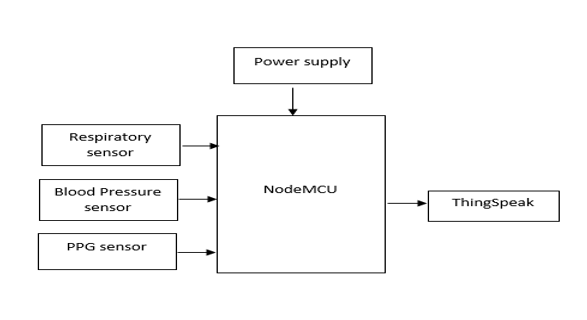
Specifications
- PPG Sensor
- BP Sensor
- NodeMCU (ESP8266)
- Power Supply (5V)
- Connecting Wires and Cables
- Cloud Platform (ThingSpeak)
Learning Outcomes
- Understanding of sensor integration and data collection techniques
- Basics of signal processing for health monitoring
- Familiarity with NodeMCU and Wi-Fi module integration
- Working with cloud platforms for data visualization (e.g., ThingSpeak)
- About Project Development Life Cycle:
- Planning and requirement gathering (software, tools, hardware components, etc.)
- Schematic preparation
- Code development and debugging
- Hardware development and debugging
- Development of the project and output testing
- Practical exposure to:
- Working with health monitoring sensors
- Real-time data transmission and cloud integration
- Solution development for health-related problems
- Working individually or as a team
- Generating creative and innovative ideas
- Project development skills:
- Problem analysis
- Problem-solving
- Creativity and imagination
- Programming
- Deployment
- Testing and debugging
- Project presentation skills
- Documentation and report writing skills


 Paper Publishing

Request Call Back
Would you like to receive a free callback now?
Choose the best time for callback:
Leave your message and we will contact you as soon as possible

6-2-85/B, Old Maternity Hospital Road, Thyagaraja Nagar, Tirupati, Andhra Pradesh – 517501
+91 9030333433
+91 9393939065
0877-2261612

Disclaimer - Takeoff Edu Group Projects are not associated or affiliated with IEEE in any way. The IEEE Projects mentioned here are mentioned in the context of student projects, whose ideas are derived from IEEE publications, not projects of or by IEEE.

