CONTACTLESS SIMULATION MODEL FOR HUMAN VITAL MONITORING USING UWB RADAR
Objective
This project simulates non-contact vital sign monitoring using Ultra-Wideband (UWB) radar in MATLAB, modeling chest motion to detect respiration and heart rate. It enables cost-effective, hardware-free biomedical signal analysis and testing.
Abstract
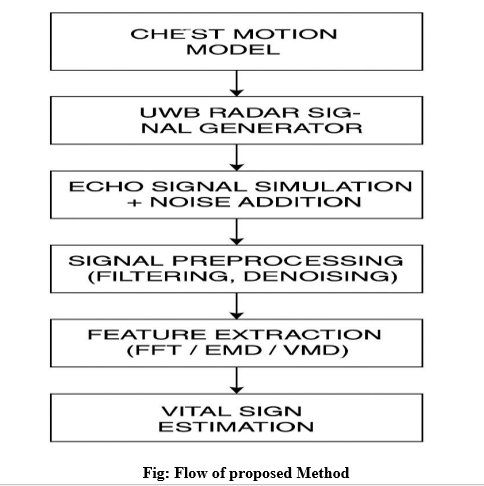
The non-contact vital sign monitoring using Ultra-Wideband (UWB) radar technology it is based on software simulation. The system aims to detect key physiological signals such as respiration rate and heart rate by modeling the chest motion of a human subject. Instead of using physical radar hardware, this project simulates radar echo signals and signal processing using MATLAB. The simulation includes radar pulse generation, chest motion modelling, signal reflection, noise addition, and digital signal processing to extract vital signs. The approach is costeffective, hardware-free, and ideal for academic, medical research, and prototype testing environments. This approach offers a low-cost and flexible platform for prototyping, academic research, and algorithm testing without the need for physical sensors. The simulated environment enables controlled testing under various conditions, including motion artifacts, noise levels, and target distances. It is particularly useful for applications in remote patient monitoring, elderly care, neonatal health assessment, and disaster response systems, where contact-based monitoring may be impractical or risky.
Key Words: Ultra-Wideband (UWB) radar, Non-contact vital sign monitoring, Radar simulation, Chest motion modelling, Heart rate detection, Respiration rate detection, Signal processing, MATLAB simulation, Biomedical signal analysis, Digital signal processing (DSP), Frequency domain analysis, Fast Fourier Transform (FFT), Non-invasive monitoring, Synthetic radar signals, Time–frequency analysis, Software-based radar system, Echo signal simulation, Remote health monitoring, Vital sign extraction, Smart healthcare systems.
NOTE: Without the concern of our team, please don't submit to the college. This Abstract varies based on student requirements.
Block Diagram
Specifications
Software: Matlab 2022b or above
Hardware:
Operating Systems:
- Windows 10
- Windows 7 Service Pack 1
- Windows Server 2019
- Windows Server 2016
Processors:
Minimum: Any Intel or AMD x86-64 processor
Recommended: Any Intel or AMD x86-64 processor with four logical cores and AVX2 instruction set support
Disk:
Minimum: 2.9 GB of HDD space for MATLAB only, 5-8 GB for a typical installation
Recommended: An SSD is recommended A full installation of all MathWorks products may take up to 29 GB of disk space
RAM:
Minimum: 4 GB
Recommended: 8 GB
Learning Outcomes
· Introduction to Matlab
· What is EISPACK & LINPACK
· How to start with MATLAB
· About Matlab language
· Matlab coding skills
· About tools & libraries
· Application Program Interface in Matlab
· About Matlab desktop
· How to use Matlab editor to create M-Files
· Features of Matlab
· Basics on Matlab
· What is Communication?
· About Communication
· Introduction to Communication
· How Communication Works?
· Importing the System Design, Characterization and Visualization
· Analyzing of BER tool
· Analyzing of Error Rate Test Console
· Generation of WSN
· WSN network creation
· Nodes Communication
· Clustering
· Routing
· Convolutional
· Equalization and Synchronization etc.,
· How to extend our work to another real time applications
· Project development Skills
o Problem analyzing skills
o Problem solving skills
o Creativity and imaginary skills
o Programming skills
o Deployment
o Testing skills
o Debugging skills
o Project presentation skills
o Thesis writing skills
Demo Video


Request for Video
 Paper Publishing
Request Call Back
Would you like to receive a free callback now?
Choose the best time for callback:
Leave your message and we will contact you as soon as possible

6-2-85/B, Old Maternity Hospital Road, Thyagaraja Nagar, Tirupati, Andhra Pradesh – 517501
+91 9030333433
+91 9393939065
0877-2261612

Disclaimer - Takeoff Edu Group Projects are not associated or affiliated with IEEE in any way. The IEEE Projects mentioned here are mentioned in the context of student projects, whose ideas are derived from IEEE publications, not projects of or by IEEE.

