Congestion-Based Traffic Control with Dynamic Algorithms and Supervised Machine Learning
Objective
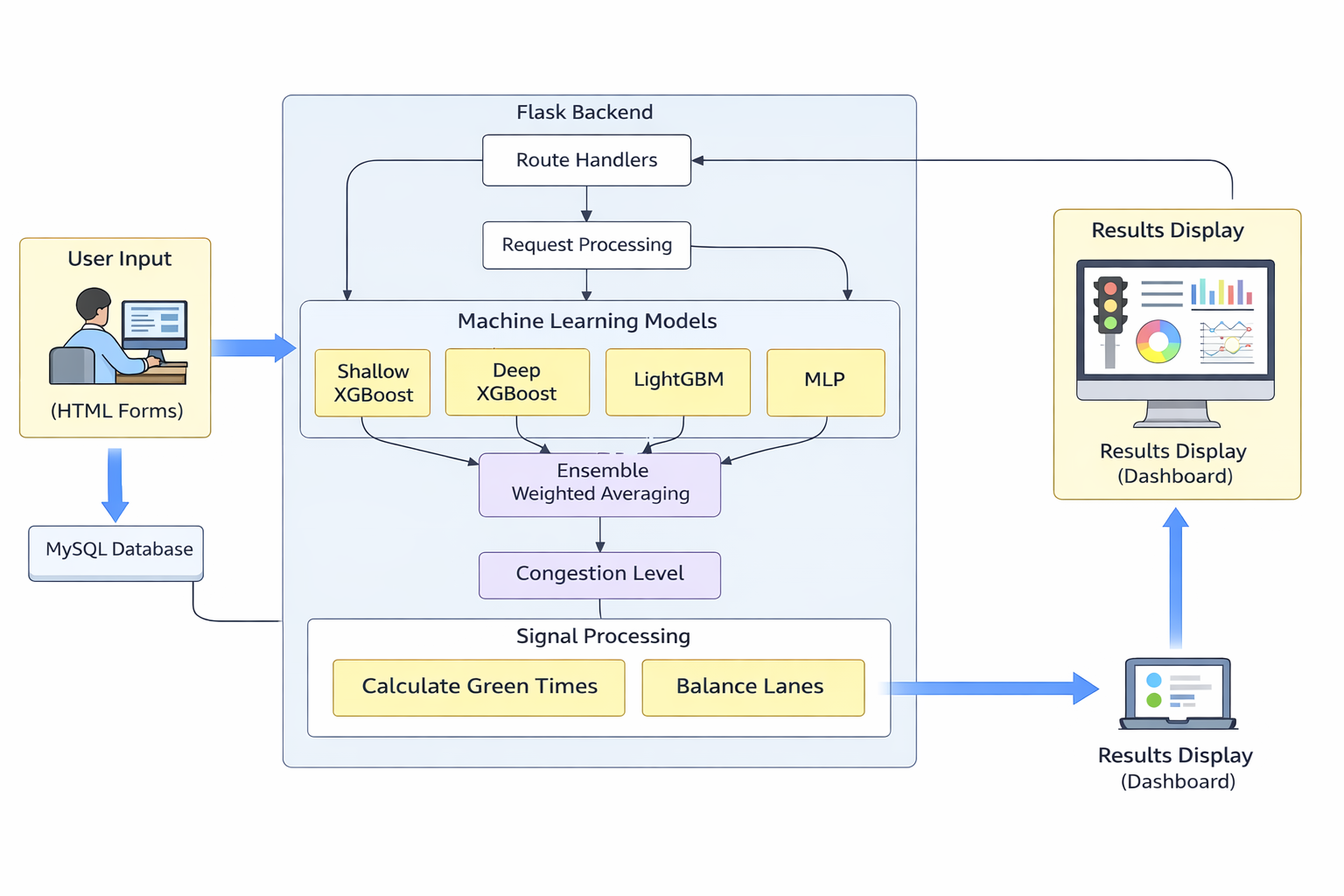
The main objective of this project is to design a hybrid system that classifies traffic congestion and optimizes signal timings using dynamic algorithms and machine learning. The system preprocesses traffic data, implements supervised models like adaptive XGBoost, HistGradientBoost, MLP, and LightGBM for congestion classification, and optimizes signal timings dynamically. A web interface is developed using Flask, HTML, CSS, and JavaScript, allowing users to interact with the system for real-time traffic prediction and classification.
Abstract
Urban traffic management has become increasingly complex due to growing vehicle density and dynamic road conditions. This project introduces a hybrid machine learning framework for intelligent traffic light control, integrating dynamic algorithms like adaptive XGBoost (shallow and deep), HistGradientBoosting, MLP, and LightGBM for congestion classification, alongside optimization techniques. The system analyzes structured traffic parameters, including timestamp-derived features (day, hour, minute), IR presence across four lanes, vehicle count, average speed, detected vehicle types, vehicle density percentage, and congestion level. Supervised machine learning models are employed to classify congestion levels, while the optimization approach dynamically adjusts signal timing strategies. This hybrid model offers predictive accuracy and adaptive signal control to enhance traffic flow. The architecture is implemented using a Flask-based backend and a web interface with HTML, CSS, and JavaScript, enabling users to register, log in, and perform traffic prediction or classification. The system improves signal coordination, reduces congestion, and enhances decision-making through intelligent automation. Experimental evaluation demonstrates improved classification performance and optimized traffic signal control strategies compared to conventional static timing systems.
Keywords: Traffic Light Control, Hybrid Machine Learning, Adaptive XGBoost, HistGradientBoosting, MLP, LightGBM, Congestion Classification, Traffic Optimization, Signal Control, Reinforcement Learning, Flask-Based Web Application
NOTE: Without the concern of our team, please don't submit to the college. This Abstract varies based on student requirements.
Block Diagram
Specifications
Hardware Requirements
• Processor - I5/Intel Processor
• RAM - 8GB (min)
• Hard Disk - 160 GB
• Key Board - Standard Windows Keyboard
• Mouse - Two or Three Button Mouse
• Monitor - Any
SOFTWARE REQUIREMENS
• Operating System : Windows 7/8/10
• Server side Script : HTML, CSS, Bootstrap & JS
• Programming Language : Python
• Libraries : Flask, Pandas, Mysql. connector, Os, Numpy, Scikit- learn, sklearn.ensemble, MLPRegressor, SVR
• IDE/Workbench : VS-Code
• Technology : Python 3.10+
• Server Deployment : Xampp Server
• Database : MySQL


 Paper Publishing

Request Call Back
Would you like to receive a free callback now?
Choose the best time for callback:
Leave your message and we will contact you as soon as possible

6-2-85/B, Old Maternity Hospital Road, Thyagaraja Nagar, Tirupati, Andhra Pradesh – 517501
+91 9030333433
+91 9393939065
0877-2261612

Disclaimer - Takeoff Edu Group Projects are not associated or affiliated with IEEE in any way. The IEEE Projects mentioned here are mentioned in the context of student projects, whose ideas are derived from IEEE publications, not projects of or by IEEE.

