Condition Monitoring of Photovoltaic Panels Through Electrical Impedance Spectroscopy and Machine Learning
Objective
The objective of this project is to enhance the accuracy and reliability of photovoltaic (PV) panel condition monitoring.
Abstract
Reliable operation of photovoltaic (PV) assets demands early detection of subtle faults and environmental stressors that degrade energy yield. This work investigates a data-driven condition-monitoring pipeline that fuses Electrical Impedance Spectroscopy (EIS) with modern machine learning to classify PV module temperature classes and degradation types (including dust deposition and microcracks). EIS measurements are transformed into informative descriptors such as frequency-domain magnitude/phase trends, Nyquist/Bode curve features, and equivalent-circuit parameters and fed to a diverse model suite. We evaluate TabNet (for end-to-end representation learning on tabular spectra), AutoML frameworks (H2O AutoML, AutoGluon) for systematic model search, and an ensemble StackingClassifier combining LightGBM, SVM, and CatBoost for robust decision-level fusion. To enable trustworthy deployment, we apply SHAP and LIME to interpret class-driving spectral regions and component parameters. For edge use cases, we further develop a lightweight neural network tailored for embedded inference on resource-constrained devices. Across varied operating conditions, the proposed approach achieves accurate and stable classification while maintaining low latency and model size suitable for on-site monitoring. The results highlight the viability of EIS-centric, explainable ML for proactive PV asset management, enabling predictive maintenance scheduling and reduced lifecycle costs.
Keywords:
Photovoltaic Panels, Electrical Impedance Spectroscopy (EIS), Condition Monitoring, Temperature Classification, Degradation Detection, Dust, Microcracks, TabNet, LightGBM, Support Vector Machine (SVM), CatBoost, StackingClassifier, Explainable AI, SHAP, LIME, Embedded Inference, Edge Computing, Nyquist/Bode Features, Equivalent Circuit Modeling, Predictive Maintenance.
NOTE: Without the concern of our team, please don't submit to the college. This Abstract varies based on student requirements.
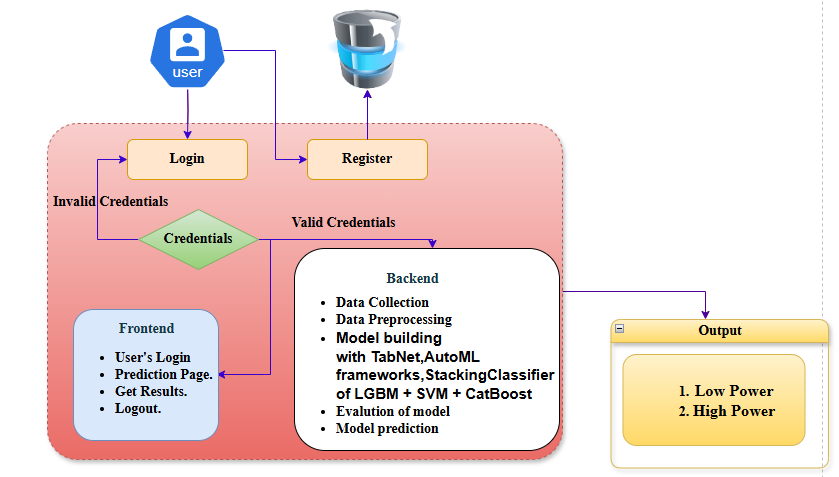
Block Diagram
Specifications
SOFTWARE REQUIREMENS
Operating System : Windows 7/8/10
Server side Script : HTML, CSS, Bootstrap & JS
Programming Language : Python
Libraries Django, Pandas, Torch, Keras, Sklearn, Numpy , Seaborn
IDE/Workbench : VSCode
Server Deployment : Xampp Server
Database : SQLite
HARDWARE REQUIREMENTS
Processor - I3/Intel Processor
RAM - 8GB (min)
Hard Disk - 128 GB
Key Board - Standard Windows Keyboard
Mouse - Two or Three Button Mouse
Monitor - Any

Demo Video


Request for Video
 Paper Publishing
Request Call Back
Would you like to receive a free callback now?
Choose the best time for callback:
Leave your message and we will contact you as soon as possible

6-2-85/B, Old Maternity Hospital Road, Thyagaraja Nagar, Tirupati, Andhra Pradesh – 517501
+91 9030333433
+91 9393939065
0877-2261612

Disclaimer - Takeoff Edu Group Projects are not associated or affiliated with IEEE in any way. The IEEE Projects mentioned here are mentioned in the context of student projects, whose ideas are derived from IEEE publications, not projects of or by IEEE.

