Computer Vision System for Automated Electronic Parts Recognition
Objective
The objective of the Computer Vision System for Automated Electronic Parts Recognition is to create an intelligent system that can automatically recognize and classify electronic components from images. Using advanced deep learning techniques like the YOLO algorithm, the system will detect parts such as resistors, capacitors, and diodes. The system aims to improve the efficiency and accuracy of identifying electronic parts in manufacturing and maintenance processes. Built with Streamlit, it provides a user-friendly web interface for easy image uploads and classification results, reducing manual inspection, minimizing errors, and streamlining electronic parts handling.
Abstract
The Computer Vision System for Automated Electronic Parts Recognition aims to develop an intelligent system capable of recognizing and classifying various electronic components from images. The system uses advanced deep learning techniques, specifically the YOLO (You Only Look Once) algorithm, to detect and classify electronic parts. The model is trained on a robust dataset of electronic parts, which includes images of resistors, capacitors, diodes, and other essential components. This research addresses the challenges of automating the identification of components in electronic manufacturing and maintenance processes, where accuracy and speed are crucial. YOLOv9 and YOLOv11 models are employed to ensure efficient and precise part detection. The system is built using the Streamlit framework, making it accessible through an intuitive web interface, allowing users to upload images and receive component classifications. This project highlights the potential for computer vision to simplify tasks that traditionally require manual inspection. The results can improve operational efficiency and reduce errors in identifying electronic parts, contributing to a more automated and streamlined approach to electronics handling.
Keywords: Computer Vision, Automated Recognition, Electronic Parts, YOLOv9, YOLOv11, Image Classification, Deep Learning, Streamlit, Detection System, Web Interface.
NOTE: Without the concern of our team, please don't submit to the college. This Abstract varies based on student requirements.
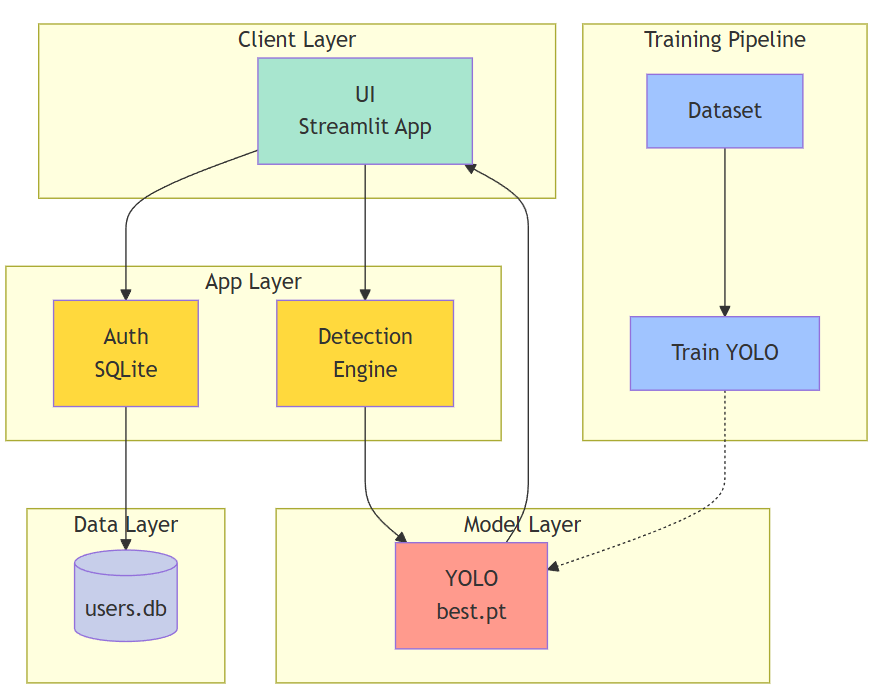
Block Diagram
Specifications
Hardware Requirements
Processor - I3/Intel Processor
Hard Disk - 160GB
Key Board - Standard Windows Keyboard
Mouse - Two or Three Button Mouse
Monitor - SVGA
RAM - 8GB
Software Requirements:
Operating System : Windows 7/8/10
Server side Script : HTML, CSS, Bootstrap & JS
Programming Language : Python
Libraries : streamlit, Os, Smtplib, Numpy
IDE/Workbench : Vscode
Technology : Python 3.12+
Server Deployment : Xampp Server
Database : MySQL


 Paper Publishing

Request Call Back
Would you like to receive a free callback now?
Choose the best time for callback:
Leave your message and we will contact you as soon as possible

6-2-85/B, Old Maternity Hospital Road, Thyagaraja Nagar, Tirupati, Andhra Pradesh – 517501
+91 9030333433
+91 9393939065
0877-2261612

Disclaimer - Takeoff Edu Group Projects are not associated or affiliated with IEEE in any way. The IEEE Projects mentioned here are mentioned in the context of student projects, whose ideas are derived from IEEE publications, not projects of or by IEEE.

