Complex Valued Multi Domain Features and Its Application in Motor Imagery Classification
Objective
The primary goal of this project is to develop a sophisticated EEG classification model that utilizes complex-valued features (phase and amplitude) to distinguish between four motor imagery tasks. By leveraging both traditional machine learning models, such as Deep Neural Networks (DNN), Convolutional Neural Networks (CNN), and XGBoost, alongside novel approaches like Stacking Classifiers, Decision Trees, and Voting Classifiers, this project aims to improve the accuracy and reliability of motor imagery classification.
Abstract
This project explores the classification of motor imagery tasks using EEG signals by leveraging both phase and amplitude information. Traditional approaches often focus on amplitude features alone, but incorporating phase information provides a more comprehensive representation of brain activity. We compare existing methods (DNN, CNN, XGBoost) with our proposed approach (Stacking classifier, Decision Tree, Voting Classifier) to demonstrate improved classification accuracy. The system has potential applications in assistive technologies for individuals with motor impairments. The extraction of features from electroencephalography (EEG) signals is a vital step in the classification of motor imagery. However, traditional feature extraction methods for EEG signals either focus either on amplitude or frequency, or the rich phase information. Furthermore, to align with the feature vectors in complex space, we developed a CVELM. Significance testing and separability analysis are employed for real-value features and CVF, the experimental results manifest the effectiveness of the CVF. Meanwhile, we evaluate our proposed method on two publicly available datasets from the representative fields of BCI, notably motor imagery decoding. The proposed model yielded better performance compared with existing state-of-the-art methods in terms of overall classification accuracy.
Keywords: Stacking Classifier, Decision Tree Classifier, voting classifier, XGBoost Classifier.
NOTE: Without the concern of our team, please don't submit to the college. This Abstract varies based on student requirements.
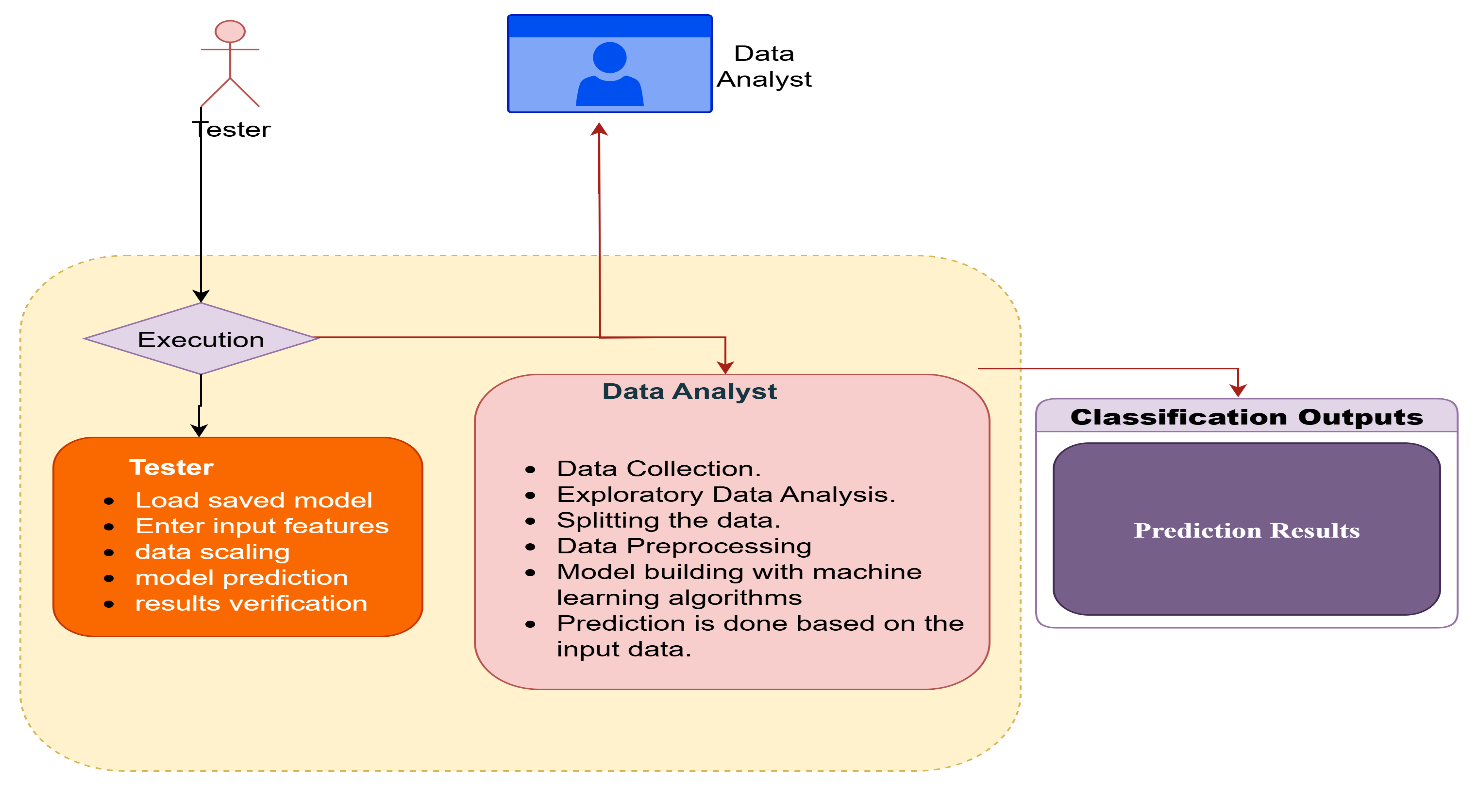
Block Diagram
Specifications
SOFTWARE REQUIREMENS
Operating System : Windows 7/8/10
Server side Script : HTML, CSS, Bootstrap & JS
Programming Language : Python
Libraries : Flask, Pandas, Os, Numpy, Scikit-learn, XGBoost.
IDE/Workbench : VS Code
Technology : Python 3.10
Database : SQLite
HARDWARE REQUIREMENTS
Processor - I3/Intel Processor
Hard Disk - 160GB
Key Board - Standard Windows Keyboard
Mouse - Two or Three Button Mouse
Monitor - SVGA
RAM -8GB


 Paper Publishing

Request Call Back
Would you like to receive a free callback now?
Choose the best time for callback:
Leave your message and we will contact you as soon as possible

6-2-85/B, Old Maternity Hospital Road, Thyagaraja Nagar, Tirupati, Andhra Pradesh – 517501
+91 9030333433
+91 9393939065
0877-2261612

Disclaimer - Takeoff Edu Group Projects are not associated or affiliated with IEEE in any way. The IEEE Projects mentioned here are mentioned in the context of student projects, whose ideas are derived from IEEE publications, not projects of or by IEEE.

