Comparison of Image Denoising using Traditional Filter and Deep Learning Methods
Objective
This paper presents a comparison of the image denoising algorithm using peak signal-to-noise ratio (PSNR) between traditional and deep learning methods on Gaussian noise and Salt and pepper noise condition. And also compare PSNR value of deep learning between noise image to noise image (N2N) learning scheme and noise image to clean image (N2C) learning scheme. At end we compare the results of PSNR values.
Abstract
Image technology is often used in our everyday life. It is useful for many applications such as telecommunication system, automation system in self-driving vehicles, surveillance system and medical research area. However, the image can be interrupted by noise from the environment or electric signal that distorts the detail of the image.
We process a comparison of the image denoising algorithm using peak signal-to-noise ratio between traditional and deep learning methods on Gaussian noise and Salt and pepper noise condition. According to the results, deep learning method has PSNR value higher than traditional method and N2C learning scheme has PSNR value higher than N2N learning scheme.
Keywords: Image De-Noising, Deep Learning, Traditional Filter, Gaussian Noise, Salt and Pepper Noise.
NOTE: Without the concern of our team, please don't submit to the college. This Abstract varies based on student requirements.
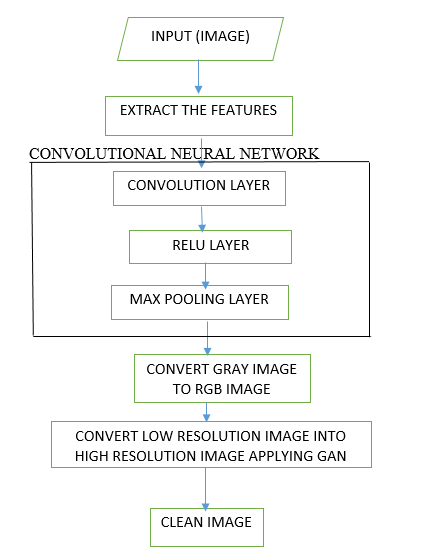
Block Diagram
Specifications
HARDWARE SPECIFICATIONS:
- Processor: I3/Intel
- Processor RAM: 4GB (min)
- Hard Disk: 128 GB
- Key Board: Standard Windows Keyboard
- Mouse: Two or Three Button Mouse
- Monitor: Any
SOFTWARE SPECIFICATIONS:
- Operating System: Windows 7+
- Server-side Script: Python 3.6+
- IDE: Google colab
- Libraries Used: Pandas, Numpy, sklearn, Flask, TensorFlow, OS.
Learning Outcomes
- Scope of real time application scenarios
- Importance of Google Colab.
- How GAN work.
- Working Procedure.
- Testing Techniques.
- Error Correction mechanisms.
- How to run and deploy the applications.
- Introduction to basic technologies.
- How project works.
- Input and Output modules.
- How test the project based on user inputs and observe the output.
- Project Development Skills:
- Problem analyzing skills.
- Problem solving skills.
- Creativity and imaginary skills.
- Programming skills.
- Deployment.
- Testing skills.
- Debugging skills.
- Project presentation skills.
- Thesis writing skills.


 Paper Publishing

Request Call Back
Would you like to receive a free callback now?
Choose the best time for callback:
Leave your message and we will contact you as soon as possible

6-2-85/B, Old Maternity Hospital Road, Thyagaraja Nagar, Tirupati, Andhra Pradesh – 517501
+91 9030333433
+91 9393939065
0877-2261612

Disclaimer - Takeoff Edu Group Projects are not associated or affiliated with IEEE in any way. The IEEE Projects mentioned here are mentioned in the context of student projects, whose ideas are derived from IEEE publications, not projects of or by IEEE.

