Comparative Study of Machine Learning and Deep Learning Models for Early Prediction of Ovarian Cancer
Objective
The objective of this project is to develop an efficient and accurate predictive model for the early detection of ovarian cancer using clinical and biomarker data. The study aims to compare machine learning (ML) and deep learning (DL) techniques, assessing their effectiveness in classifying cancerous and non-cancerous cases. The project focuses on optimizing data preprocessing, including handling missing values, outlier removal, and normalization, while utilizing feature selection methods like SelectKBest, and autoencoders. By evaluating classifiers such as LightGBM, CatBoost, hybrid models, and deep networks, the project seeks to identify the most reliable model for early diagnosis
Abstract
Ovarian cancer is one of the most challenging gynecological cancers to diagnose early, which significantly impacts survival rates. This study presents a comparative analysis of machine learning (ML) and deep learning (DL) models for the early prediction of ovarian cancer using clinical and biomarker data. The dataset undergoes comprehensive preprocessing, including handling missing values, outlier removal, normalization, and dimensionality reduction via SelectKBest. Feature selection methods such as Feature Importance, and autoencoder-based techniques are employed to enhance model performance. A variety of classifiers, including LightGBM, CatBoost, and a hybrid model (Random Forest + Gradient Boosting), along with deep learning models like Multi-layer Perceptron (MLP), are evaluated. Ensemble models, including the Voting Classifier, are also implemented. The results demonstrate that the CatBoost model, combined with optimized feature selection techniques, achieved the highest accuracy of 88%, showcasing its potential as a reliable tool for the early prediction of ovarian cancer. This study emphasizes the importance of integrating optimized preprocessing, feature engineering, and appropriate model selection to achieve effective early diagnosis.
Keywords: Ovarian cancer, early prediction, machine learning, deep learning, feature selection, CatBoost, LightGBM, hybrid model, ensemble learning, predictive modeling, clinical data, biomarker data, Recursive Feature Elimination, SelectKBest, Multi-layer Perceptron, Voting Classifier.
NOTE: Without the concern of our team, please don't submit to the college. This Abstract varies based on student requirements.
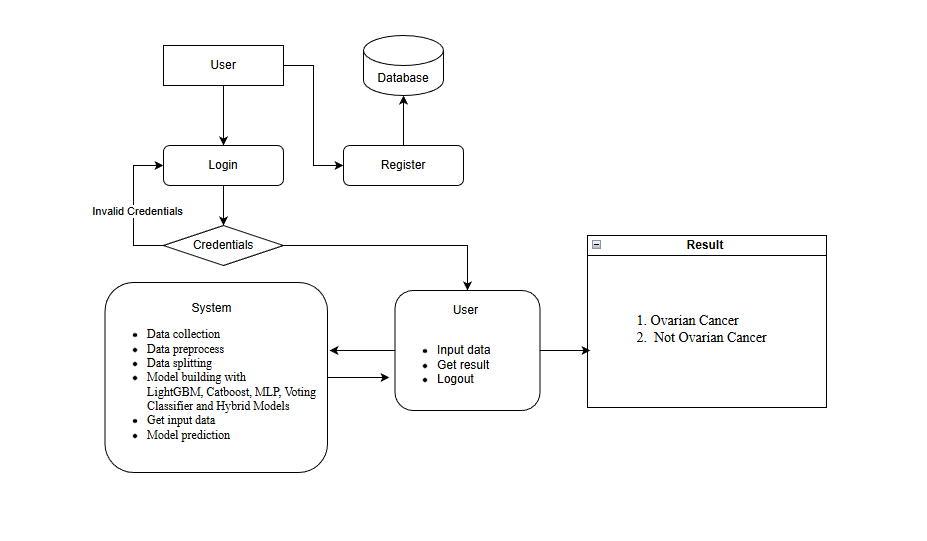
Block Diagram
Specifications
Hardware Requirements
Processor - I3/Intel Processor
Hard Disk - 160GB
Key Board - Standard Windows Keyboard
Mouse - Two or Three Button Mouse
Monitor - SVGA
RAM - 8GB
Software Requirements:
Operating System : Windows 7/8/10
Server side Script : HTML, CSS, Bootstrap & JS
Programming Language : Python
Libraries : Django, Pandas, Numpy, Tensorflow, Scikit-learn.
IDE/Workbench : VS Code
Technology : Python 3.10
Database : SQLite


 Paper Publishing

Request Call Back
Would you like to receive a free callback now?
Choose the best time for callback:
Leave your message and we will contact you as soon as possible

6-2-85/B, Old Maternity Hospital Road, Thyagaraja Nagar, Tirupati, Andhra Pradesh – 517501
+91 9030333433
+91 9393939065
0877-2261612

Disclaimer - Takeoff Edu Group Projects are not associated or affiliated with IEEE in any way. The IEEE Projects mentioned here are mentioned in the context of student projects, whose ideas are derived from IEEE publications, not projects of or by IEEE.

