Comparative Study of Machine Learning and Deep Learning Models for Early Prediction of Ovarian Cancer
Objective
The objective of this study is to compare classical machine learning and deep learning models for early ovarian cancer risk prediction using high-dimensional, multi-modal patient data to enhance diagnostic accuracy and personalized care.
Abstract
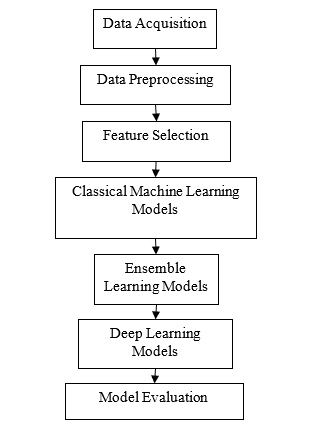
Early detection of ovarian cancer is critical for improving patient survival and enabling timely therapeutic interventions. This study presents a comprehensive comparative analysis of classical machine learning and deep learning models for the prediction of ovarian cancer risk using a high-dimensional, multi-modal dataset comprising 200,100 patient records collected from January 2019 to December 2024. The dataset integrates clinical, genetic, imaging, reproductive, hormonal, and demographic features, including biomarkers such as CA-125, BRCA mutations, SNPs, miRNA levels, radiomic tumor characteristics, and patient lifestyle indicators. After preprocessing and robust feature scaling, the top 30 most informative predictors were selected using Random Forest-based importance scores. Classical models, including K-Nearest Neighbors, Support Vector Machines, Random Forest, and logistic regression, were trained and evaluated alongside ensemble approaches like Bagging and Stacking. Deep learning architectures, specifically an improved feedforward neural network (FNN) and a deep artificial neural network (ANN) implemented via MATLAB’s patternnet and trainNetwork, were optimized for multi-class risk prediction. Comparative results demonstrated superior performance of SVM and Random Forest models (~93–94% accuracy), while deep learning models achieved competitive accuracy (~78–83%). The findings highlight the potential of hybrid predictive frameworks leveraging multi-modal patient data for early ovarian cancer detection, offering a robust foundation for personalized risk stratification and precision medicine applications.
Keywords: Ovarian Cancer Prediction, Machine Learning, Deep Learning, Multi-Modal Patient Data, Early Detection.
NOTE: Without the concern of our team, please don't submit to the college. This Abstract varies based on student requirements.
Block Diagram
Specifications
Software: Matlab 2022b or above
Hardware:
Operating Systems:
- Windows 10
- Windows 7 Service Pack 1
- Windows Server 2019
- Windows Server 2016
Processors:
Minimum: Any Intel or AMD x86-64 processor
Recommended: Any Intel or AMD x86-64 processor with four logical cores and AVX2 instruction set support
Disk:
Minimum: 2.9 GB of HDD space for MATLAB only, 5-8 GB for a typical installation
Recommended: An SSD is recommended A full installation of all MathWorks products may take up to 29 GB of disk space
RAM:
Minimum: 4 GB
Recommended: 8 GB
Learning Outcomes
· Introduction to Matlab
· What is EISPACK & LINPACK
· How to start with MATLAB
· About Matlab language
· Matlab coding skills
· About tools & libraries
· Application Program Interface in Matlab
· About Matlab desktop
· How to use Matlab editor to create M-Files
· Features of Matlab
· Basics on Matlab
· What is an Image/pixel?
· About image formats
· Introduction to Image Processing
· How digital image is formed
· Importing the image via image acquisition tools
· Analyzing and manipulation of image.
· Phases of image processing:
o Acquisition
o Image enhancement
o Image restoration
o Color image processing
o Image compression
o Morphological processing
o Segmentation etc.,
· How to extend our work to another real time applications
· Project development Skills
o Problem analyzing skills
o Problem solving skills
o Creativity and imaginary skills
o Programming skills
o Deployment
o Testing skills
o Debugging skills
o Project presentation skills
o Thesis writing skills
Demo Video


Request for Video
 Paper Publishing
Request Call Back
Would you like to receive a free callback now?
Choose the best time for callback:
Leave your message and we will contact you as soon as possible

6-2-85/B, Old Maternity Hospital Road, Thyagaraja Nagar, Tirupati, Andhra Pradesh – 517501
+91 9030333433
+91 9393939065
0877-2261612

Disclaimer - Takeoff Edu Group Projects are not associated or affiliated with IEEE in any way. The IEEE Projects mentioned here are mentioned in the context of student projects, whose ideas are derived from IEEE publications, not projects of or by IEEE.

