Comparative Analysis of Pixel Based Segmentation Models for Accurate Detection of Impacted Teeth on Panoramic Radiographs
Objective
The primary objective of this project is to develop an accurate and efficient deep learning-based system for adult tooth segmentation using medical images. By leveraging multiple cutting-edge models such as U-Net, Unet2, Unet++, DeepLabv3+, and SwinUNet, the project aims to identify and isolate tooth structures from complex oral imagery. The goal is to enhance the quality of dental diagnostics, enabling precise treatment planning, automated monitoring, and reduced manual workload for dental professionals. The implementation also seeks to compare the performance of CNN-based architectures against transformer-based models in the context of medical image segmentation. Evaluation metrics like Intersection over Union (IoU) and Dice coefficient are used to assess the models' accuracy. Ultimately, the objective is to propose a robust deep learning pipeline that can be adopted in dental applications, offering both high precision and computational efficiency.
Abstract
Accurate detection of impacted teeth in panoramic radiographs plays a vital role in the diagnosis and treatment planning process within the field of dentistry. Traditional image segmentation methods often struggle with accurately identifying dental structures due to the complex and variable nature of human teeth. This study presents a comprehensive comparative analysis of advanced pixel-based segmentation models aimed at enhancing the accuracy of impacted teeth detection. Specifically, the study evaluates three models: UNet2, UNet3, and a hybrid model combining UNet with a Transformer architecture. The models are tested on a dataset of children's dental panoramic radiographs, sourced from the Kaggle dataset "Children's Dental Panoramic Radiographs," which contains high-resolution images with varying degrees of tooth impaction. The evaluation focuses on model performance across several key metrics, including segmentation accuracy, precision, recall, and F1-score. Results indicate that the hybrid UNet-Transformer model outperforms traditional models in terms of segmentation accuracy, demonstrating the potential of combining convolutional neural networks (CNNs) and attention mechanisms for complex image segmentation tasks. This research aims to provide a robust solution for improving automated dental diagnosis and support clinicians in making informed treatment decisions.
Keywords: Panoramic radiographs, impacted teeth detection, image segmentation, UNet, UNet3, hybrid model, Transformer, dental radiographs, machine learning, convolutional neural networks (CNN), attention mechanisms.
NOTE: Without the concern of our team, please don't submit to the college. This Abstract varies based on student requirements.
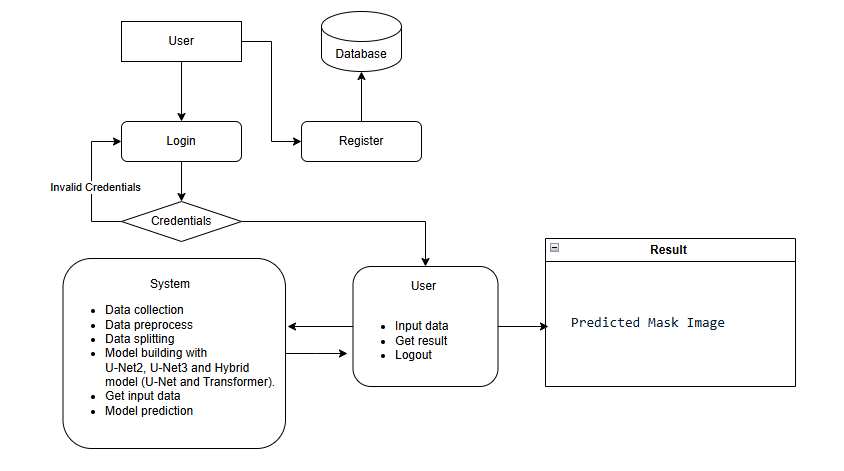
Block Diagram
Specifications
Hardware Requirements
Processor - I3/Intel Processor
Hard Disk - 160GB
Key Board - Standard Windows Keyboard
Mouse - Two or Three Button Mouse
Monitor - SVGA
RAM - 8GB
Software Requirements:
Operating System : Windows 7/8/10
Server side Script : HTML, CSS, Bootstrap & JS
Programming Language : Python
Libraries : Django, Pandas, Numpy, Tensorflow, Transformer.
IDE/Workbench : VS Code
Technology : Python 3.10
Database : SQLite

Demo Video


Request for Video
 Paper Publishing
Request Call Back
Would you like to receive a free callback now?
Choose the best time for callback:
Leave your message and we will contact you as soon as possible

6-2-85/B, Old Maternity Hospital Road, Thyagaraja Nagar, Tirupati, Andhra Pradesh – 517501
+91 9030333433
+91 9393939065
0877-2261612

Disclaimer - Takeoff Edu Group Projects are not associated or affiliated with IEEE in any way. The IEEE Projects mentioned here are mentioned in the context of student projects, whose ideas are derived from IEEE publications, not projects of or by IEEE.

