Comparative Analysis of Machine Learning Algorithms With Advanced Feature Extraction for ECG Signal Classification
Objective
The primary objective of this project is to enhance the classification of Electrocardiogram (ECG) signals through the application of advanced machine learning algorithms, with a focus on improving the diagnosis and early detection of cardiovascular diseases. The project aims to evaluate and compare the performance of various machine learning techniques, including Gradient Boosting, Stacking Classifier, Voting Classifier, XGBoost, and CatBoost, in accurately classifying ECG signals into normal and abnormal categories. By employing advanced feature extraction methods, the project seeks to identify the most effective algorithms for analysing complex ECG data, offering a more reliable, automated, and cost-efficient solution for heart disease diagnostics..
Abstract
The growing prevalence of cardiovascular diseases necessitates the development of efficient and accurate diagnostic tools. Electrocardiogram (ECG) signal classification, facilitated by machine learning algorithms, has emerged as a promising method for improving the diagnosis and early detection of heart diseases. This study presents a comparative analysis of various machine-learning algorithms, namely Gradient Boosting, Stacking Classifier, Voting Classifier, XGBoost, and CatBoost, for the classification of ECG signals. By leveraging advanced feature extraction techniques, we explore the effectiveness of these algorithms in distinguishing between normal and abnormal ECG patterns. The proposed methodology demonstrates the potential of machine learning in automating ECG signal analysis, thereby enhancing diagnostic accuracy and reducing the reliance on traditional, time-consuming manual interpretations. Additionally, the integration of these techniques offers a cost-effective solution, particularly in resource-constrained settings where access to expert cardiologists may be limited. The results of this study contribute to the ongoing efforts to improve heart disease detection systems using machine learning.
Keywords: ECG Classification, Machine Learning, Feature Extraction, Gradient Boosting, Stacking Classifier, Voting Classifier, XGBoost, CatBoost, Cardiovascular Diseases, Early Diagnosis.
NOTE: Without the concern of our team, please don't submit to the college. This Abstract varies based on student requirements.
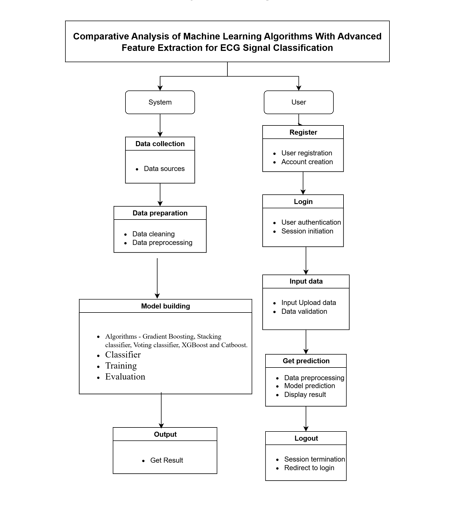
Block Diagram
Specifications
Hardware Requirements
Processor - I3/Intel Processor
Hard Disk - 160GB
Key Board - Standard Windows Keyboard
Mouse - Two or Three Button Mouse
Monitor - SVGA
RAM - 8GB
Software Requirements:
Operating System : Windows 7/8/10
Server side Script : HTML, CSS, Bootstrap & JS
Programming Language : Python
Libraries : Django, Pandas, Os, Numpy, Scikit-learn, XGBoost.
IDE/Workbench : VS Code
Technology : Python 3.10
Database : SQLite


 Paper Publishing

Request Call Back
Would you like to receive a free callback now?
Choose the best time for callback:
Leave your message and we will contact you as soon as possible

6-2-85/B, Old Maternity Hospital Road, Thyagaraja Nagar, Tirupati, Andhra Pradesh – 517501
+91 9030333433
+91 9393939065
0877-2261612

Disclaimer - Takeoff Edu Group Projects are not associated or affiliated with IEEE in any way. The IEEE Projects mentioned here are mentioned in the context of student projects, whose ideas are derived from IEEE publications, not projects of or by IEEE.

