Comparative analysis of aes, des and algorithms on Spartan 3 fpga board
Objective
In this comparative analysis, we will evaluate the strengths and weaknesses of both algorithms in terms of security, performance, and implementation complexity.
Abstract
The Advanced Encryption Standard (AES) and Data Encryption Standard (DES) are two widely used encryption algorithms in security applications. In this comparative analysis, we will evaluate the strengths and weaknesses of both algorithms in terms of security, performance, and implementation complexity. AES is a symmetric encryption algorithm that uses a block cipher with a key length of 128, 192, or 256 bits. It is considered to be one of the most secure encryption algorithms and has been adopted as a standard by many organizations and governments. AES uses a substitution-permutation network (SPN) structure that makes it resistant to known attacks such as linear and differential cryptanalysis. On the other hand, DES is also a symmetric encryption algorithm that uses a block cipher with a fixed key length of 56 bits. While DES was once widely used, its small key size makes it vulnerable to brute-force attacks, and it is now considered to be insecure for most applications. However, it is still used in legacy systems and some specialized applications.
NOTE: Without the concern of our team, please don't submit to the college. This Abstract varies based on student requirements.
Block Diagram
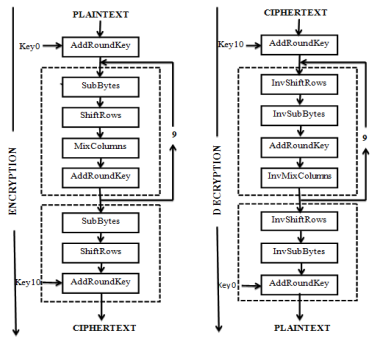
Specifications
Software Requirements:
· Xilinx ISE Tool
· HDL: Verilog
Hardware Requirements:
· Microsoft® Windows XP,
· Intel® Pentium® 4 processor or Pentium 4 equivalent with SSE support
· 512 MB RAM
· 100 MB of available disk space
Learning Outcomes
- Basics of Digital Electronics
- FPGA design Flow
- Introduction to Verilog Coding
- Different modeling styles in Verilog
o Data Flow modeling
o Structural modeling
o Behavioral modeling
o Mixed level modeling
- Concept of Cryptography systems
- Importance of Crypto systems
- Drawbacks of existing methods
- Introduction to Advanced Encryption standard (AES)
- Knowledge on pipelining concept
- Knowledge on Symmetric, Asymmetric and Hash functions
- Applications of AES in real time
- Scope of AES concept in today’s world
- Applications in real time
· Xilinx ISE 14.7/Xilinx Vivado for design and simulation
· Generation of Netlist
· Solution providing for real time problems
· Project Development Skills:
o Problem Analysis Skills
o Problem Solving Skills
o Logical Skills
o Designing Skills
o Testing Skills
o Debugging Skills
o Presentation Skills
Thesis Writing Skills


 Paper Publishing

Request Call Back
Would you like to receive a free callback now?
Choose the best time for callback:
Leave your message and we will contact you as soon as possible

6-2-85/B, Old Maternity Hospital Road, Thyagaraja Nagar, Tirupati, Andhra Pradesh – 517501
+91 9030333433
+91 9393939065
0877-2261612

Disclaimer - Takeoff Edu Group Projects are not associated or affiliated with IEEE in any way. The IEEE Projects mentioned here are mentioned in the context of student projects, whose ideas are derived from IEEE publications, not projects of or by IEEE.

