Coin Operated Water ATM with Bottle Dispenser
Objective
The objective of Coin Operated Water ATM with Bottle Dispenser is to design an automated system that dispenses purified water and bottles upon coin insertion. It provides an affordable, user-friendly, and efficient solution for clean drinking water access.
Abstract
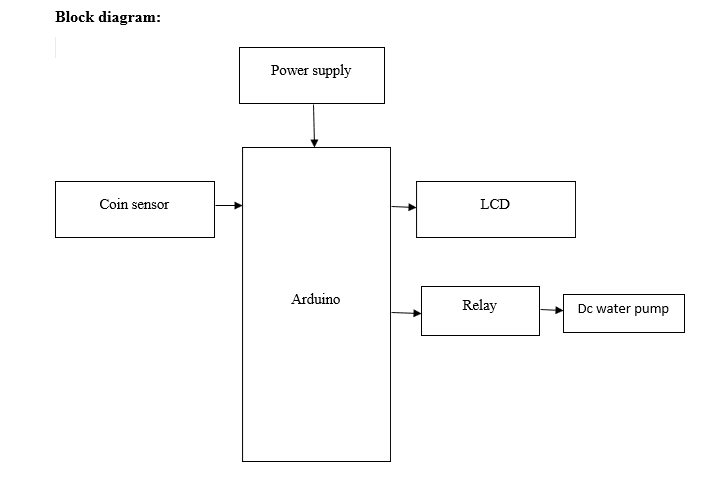
This project presents the design and development of a Coin Operated Water ATM integrated with a bottle dispenser system, aimed at providing easy access to clean drinking water in a controlled and automated manner. The system is built around an Arduino micro controller, which acts as the central control unit, managing inputs from a coin sensor and displaying information on an LCD screen. When a valid coin is inserted, the Arduino activates a relay that powers a DC water pump to dispense a predefined amount of water into a bottle. To enhance user experience and ensure smooth operation, a buzzer is included to provide audio feedback for coin validation and error notifications. The entire setup is powered by a stable power supply to maintain consistent performance. This solution is cost-effective, user-friendly, and promotes water conservation by dispensing water only upon payment, making it suitable for public places and areas with limited access to clean water.
NOTE: Without the concern of our team, please don't submit to the college. This Abstract varies based on student requirements.
Block Diagram
Specifications
Hardware Requirements:
- Arduino
- Coin sensor
- Relay
- Dc water pump
- Lcd
- Power supply
Software Requirements:
- Embedded c
- Arduino idle
Learning Outcomes
Understanding Arduino pin diagram and architecture
Installing and configuring Arduino IDE for Arduino
Setting up Arduino for multi-sensor
Basic coding with Arduino for applications
Working with coin sensor
Interfacing LCD with Arduino for real-time display
Interfacing Relay readers with Arduino
Interfacing pump with Arduino
Interfacing buzzer with Arduino
Understanding power supply requirements for wearable devices
About Project Development Life Cycle:
- Planning and Requirement Gathering (software, tools, hardware components, etc.)
- Schematic preparation
- Code development and debugging
- Hardware setup and debugging
- Development of the Project and Output testing
Practical exposure to:
- Hardware and software tools
- Solution providing for real-time problems
- Working with a team/individually
- Working on creative ideas
Project development skills:
- Problem analysis
- Problem solving
- Creativity and imagination
- Programming skills (Python)
- Deployment
- Testing
- Debugging
- Project presentation
- Report writing


 Paper Publishing

Request Call Back
Would you like to receive a free callback now?
Choose the best time for callback:
Leave your message and we will contact you as soon as possible

6-2-85/B, Old Maternity Hospital Road, Thyagaraja Nagar, Tirupati, Andhra Pradesh – 517501
+91 9030333433
+91 9393939065
0877-2261612

Disclaimer - Takeoff Edu Group Projects are not associated or affiliated with IEEE in any way. The IEEE Projects mentioned here are mentioned in the context of student projects, whose ideas are derived from IEEE publications, not projects of or by IEEE.

