Cognitive Cyber Security Analysis Using Machine Learning Approaches
Objective
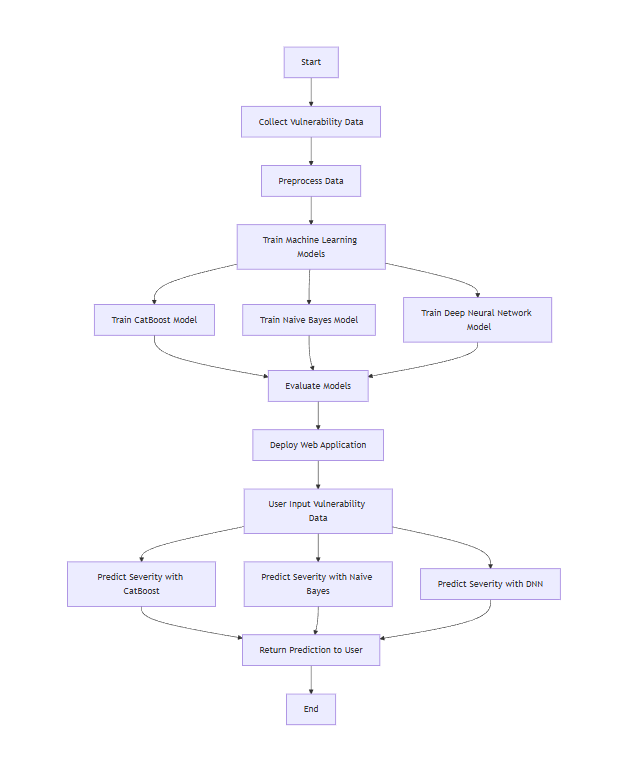
The primary objective of this project is to develop an automated machine learning model capable of classifying the severity of cyber security vulnerabilities into one of four categories: LOW, MEDIUM, HIGH, and CRITICAL. To achieve this, the project will begin by collecting a comprehensive dataset containing vulnerabilities along with their associated CVSS scores, CWE identifiers, and descriptions. This data will undergo preprocessing, including cleaning and feature engineering, to make it suitable for machine learning. The next step involves developing and implementing three machine learning algorithms—CatBoost, Naive Bayes, and Deep Neural Networks (DNN)—which will be trained on the dataset to predict vulnerability severity. Once the models are trained, they will be evaluated using performance metrics such as accuracy, precision, recall, and F1-score to assess their classification capabilities. A user-friendly web-based application will then be built to allow users to input vulnerability data and receive severity predictions from the trained models. The system will be integrated and tested to ensure accurate predictions and smooth functionality. Lastly, detailed documentation will be provided, covering the methodologies used, the results obtained, and suggestions for future enhancements.
Abstract
The field of cyber security has become increasingly important as organizations strive to protect their digital assets from a growing number of threats. Identifying and mitigating these threats promptly is crucial, and one of the primary methods of doing so is through the assessment of vulnerability severity. This project focuses on using machine learning techniques to analyze cyber security vulnerabilities and predict their severity. By examining key factors such as CVSS scores (CVSS-V4, CVSS-V3, CVSS-V2), CWE identifiers, and textual descriptions of vulnerabilities, the project aims to develop a predictive model that can classify vulnerabilities into one of four severity categories: LOW, MEDIUM, HIGH, and CRITICAL. The machine learning algorithms employed in this project include CatBoost, Naive Bayes, and Deep Neural Networks (DNN). These models are trained using historical vulnerability data, evaluated using performance metrics like accuracy, precision, recall, and F1-score, and ultimately used for predicting the severity of future vulnerabilities. The project also involves the development of a web-based application where users can input vulnerability details and receive a severity classification. This tool will be useful for cyber security professionals in assessing potential threats and prioritizing remediation efforts. Through this project, the goal is to enhance decision-making in cyber security, ensuring that critical vulnerabilities are promptly addressed.
Keywords: Cyber security, machine learning, vulnerability severity, CVSS scores, CWE identifiers, CatBoost, Naive Bayes, Deep Neural Networks, classification, predictive model.
NOTE: Without the concern of our team, please don't submit to the college. This Abstract varies based on student requirements.
Block Diagram
Specifications
HARDWARE REQUIREMENTS
• Processor - I5/Intel Processor
• RAM - 8GB (min)
• Hard Disk - 160 GB
• Key Board - Standard Windows Keyboard
• Mouse - Two or Three Button Mouse
• Monitor - Any
SOFTWARE REQUIREMENS
• Operating System : Windows 7/8/10
• Server side Script : HTML, CSS, Bootstrap & JS
• Programming Language : Python
• Libraries : Flask, Pandas, Mysql.connector, Os, Numpy,
Scikit-learn.
• IDE/Workbench : VS-Code
• Technology : Python 3.10+
• Server Deployment : Xampp Server
• Database : MySQL


 Paper Publishing

Request Call Back
Would you like to receive a free callback now?
Choose the best time for callback:
Leave your message and we will contact you as soon as possible

6-2-85/B, Old Maternity Hospital Road, Thyagaraja Nagar, Tirupati, Andhra Pradesh – 517501
+91 9030333433
+91 9393939065
0877-2261612

Disclaimer - Takeoff Edu Group Projects are not associated or affiliated with IEEE in any way. The IEEE Projects mentioned here are mentioned in the context of student projects, whose ideas are derived from IEEE publications, not projects of or by IEEE.

