Coffee Bean Defects Automatic Classification Realtime Application Adopting Deep Learning
Objective
The main objective of this project is to develop a real-time automated system for detecting and classifying defects in coffee beans using deep learning. By leveraging image-based analysis and advanced convolutional neural network models, the system aims to accurately identify defect categories such as Black, Broken, Brown, BigBroken, Immature, Insect-damaged, Mixed, Mold, and PartlyBlack. This automation reduces dependency on manual inspection, minimizes human error, and improves processing speed and quality consistency. The project ultimately seeks to enhance efficiency in coffee production, ensure standardized grading, and support industrial automation through a scalable and reliable quality control solution.
Abstract
Automated quality inspection has become essential in modern coffee production to ensure consistency, safety, and market value. Traditional manual sorting of coffee beans is time-consuming, labor-intensive, and prone to human error, especially when distinguishing visually similar defect types. This study presents a real-time deep learning–based application for automatic classification of coffee bean defects using the publicly available Coffee Beans dataset from Kaggle. The system identifies multiple defect categories, including Black, Broken, Brown, BigBroken, Immature, Insect-damaged, Mixed, Mold, and PartlyBlack beans. The proposed workflow integrates image preprocessing, data augmentation, and transfer learning using state-of-the-art convolutional neural network architectures to enhance accuracy under varying lighting and orientation conditions. The trained model is deployed in a lightweight real-time application capable of processing video streams or conveyor belt camera inputs, making it suitable for industrial use.
Experimental evaluations demonstrate high classification accuracy and robust performance against noise, overlapping beans, and background variability. The real-time implementation provides instant defect detection and visualization, enabling immediate decision-making for sorting or rejection. Compared to manual inspection, the system significantly reduces labor costs, increases throughput, and offers consistent, replicable quality control. This work contributes to the agricultural automation domain by proving that deep learning can outperform traditional image processing techniques and manual sorting in both speed and reliability. The proposed application can be extended to additional bean varieties, defect types, and integrated with robotic sorting systems for a fully automated processing pipeline.
Keywords: Coffee beans, deep learning, real-time detection, defect classification, quality control, convolutional neural networks, automation
NOTE: Without the concern of our team, please don't submit to the college. This Abstract varies based on student requirements.
Block Diagram
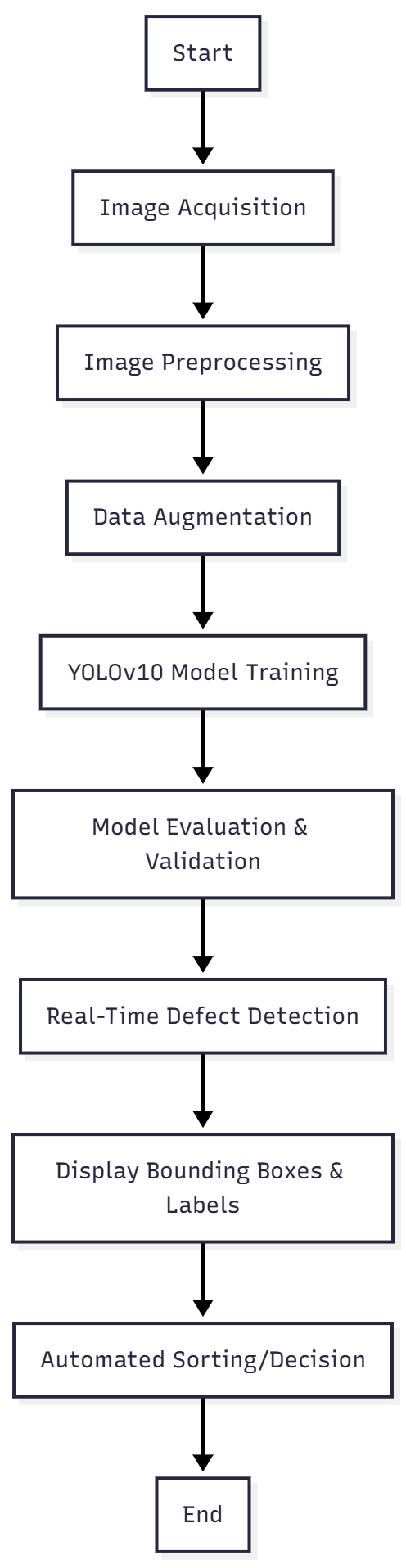
Specifications
SOFTWARE REQUIREMENS
Operating System : Windows 7/8/10
Server side Script : HTML, CSS, Bootstrap & JS
Programming Language : Python
Libraries Flask, Pandas, Torch, Sklearn, Numpy , Seaborn, Matplotlib
IDE/Workbench : VSCode
Server Deployment : Xampp Server
Database : MySQL
HARDWARE REQUIREMENTS
Processor - I3/Intel Processor
RAM - 8GB (min)
Hard Disk - 128 GB
Key Board - Standard Windows Keyboard
Mouse - Two or Three Button Mouse
Monitor - Any


 Paper Publishing

Request Call Back
Would you like to receive a free callback now?
Choose the best time for callback:
Leave your message and we will contact you as soon as possible

6-2-85/B, Old Maternity Hospital Road, Thyagaraja Nagar, Tirupati, Andhra Pradesh – 517501
+91 9030333433
+91 9393939065
0877-2261612

Disclaimer - Takeoff Edu Group Projects are not associated or affiliated with IEEE in any way. The IEEE Projects mentioned here are mentioned in the context of student projects, whose ideas are derived from IEEE publications, not projects of or by IEEE.

