CNN Based Model for Early Glaucoma Detection from Retinal Fundus Images
Objective
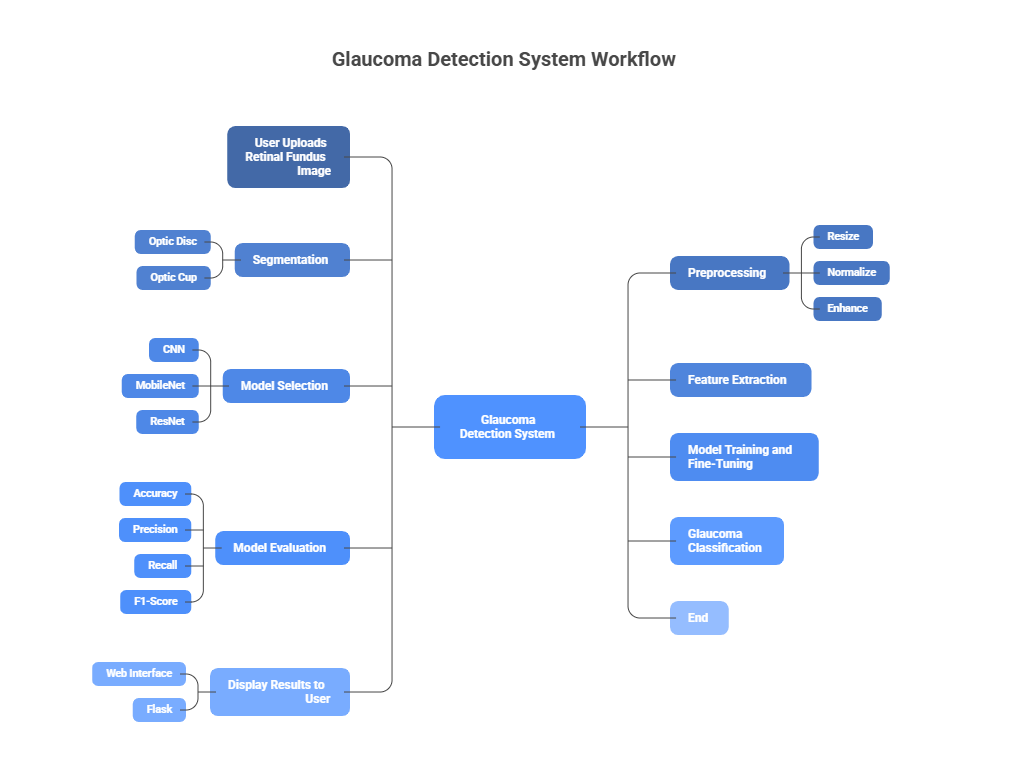
The objective of this project is to develop a deep learning-based system for accurate glaucoma detection using retinal fundus images. By leveraging CNN, MobileNet, and ResNet models, the system aims to provide robust feature extraction and classification for early detection of glaucoma. The approach ensures high efficiency and scalability, offering real-time detection through a user-friendly Flask web interface. Future objectives include optimizing the model, enhancing accuracy, and expanding the system for broader ophthalmic disorder detection. The system aims to contribute to early diagnosis and prevention of irreversible vision loss.
Abstract
Glaucoma is a leading cause of irreversible blindness worldwide, and early detection is crucial for preventing vision loss. This project, titled "CNN-Based Glaucoma Detection Using Retinal Fundus Images", presents a deep learning framework for the accurate classification of glaucoma in retinal images. The system leverages Convolutional Neural Networks (CNN), MobileNet, and ResNet models for robust feature extraction and classification. The models are trained on the HIGAN-CNN Glaucoma Detection dataset from Kaggle, which contains labeled retinal fundus images for detecting glaucoma and normal cases. The image preprocessing pipeline involves resizing, normalization, and feature extraction using the pre-trained MobileNet and ResNet models, followed by classification via CNN-based architectures. The system is deployed through a Flask web interface, enabling users to upload retinal images and receive immediate glaucoma detection results. The modular architecture supports potential future expansions, including additional models and techniques for enhanced accuracy. This approach demonstrates the power of deep learning in medical image classification, offering an efficient and scalable solution for real-time glaucoma detection. Future work will focus on model optimization, real-time monitoring, and integration of advanced features for broader ophthalmic disorder detection.
Keywords
Glaucoma, CNN, MobileNet, ResNet, Retinal Fundus Images, Deep Learning, Flask
Deployment, Medical Image Classification, Real-time Detection, Transfer
Learning.
NOTE: Without the concern of our team, please don't submit to the college. This Abstract varies based on student requirements.
Block Diagram
Specifications
H/W CONFIGURATION:
u Processor - I3/Intel Processor
u Hard Disk -160 GB
u RAM - 8 GB
S/W CONFIGURATION:
u Operating System: Windows 10/11 or Linux (Ubuntu)
u Programming Language: Python
u Web Framework: Flask
u Machine Learning Libraries: TensorFlow, Keras, PyTorch
u Data Handling Libraries: Pandas, NumPy
u Image Processing Libraries: OpenCV, PIL (Pillow)
u Database: MySQL
u Version Control: Git
u IDE: VS Code or PyCharm
u Web Technologies: HTML, CSS, JavaScript
u Visualization Libraries: Matplotlib, Seaborn


 Paper Publishing

Request Call Back
Would you like to receive a free callback now?
Choose the best time for callback:
Leave your message and we will contact you as soon as possible

6-2-85/B, Old Maternity Hospital Road, Thyagaraja Nagar, Tirupati, Andhra Pradesh – 517501
+91 9030333433
+91 9393939065
0877-2261612

Disclaimer - Takeoff Edu Group Projects are not associated or affiliated with IEEE in any way. The IEEE Projects mentioned here are mentioned in the context of student projects, whose ideas are derived from IEEE publications, not projects of or by IEEE.

