CLASSIFICATION OF APNEA USING BREATH RATE ESTIMATIONS FROM ECG AND PPG SIGNALS
Objective
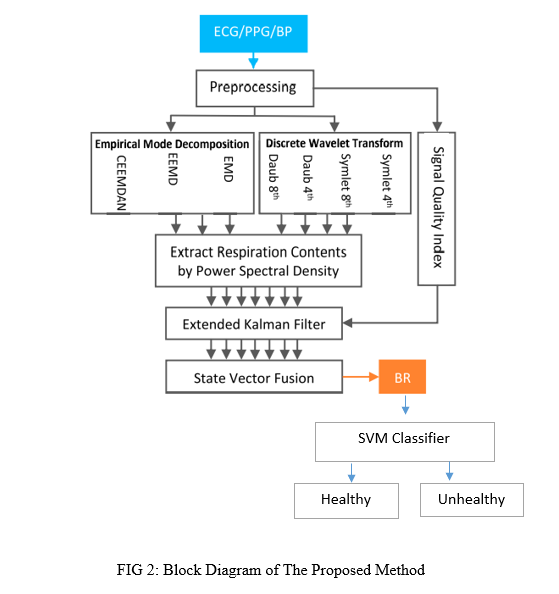
A novel framework for estimating Breathing Rate (BR) from ECG and PPG signals uses Empirical Mode Decomposition, Discrete Wavelet Transform, and an Extended Kalman Filter to ensure accuracy and robustness, even in high-noise environments.
Abstract
Breathing Rate (BR) is a key physiological parameter measured in a wide range of clinical settings. However, it is still widely measured manually. In this paper, a novel framework is proposed to estimate the BR from an electrocardiogram (ECG) and a photoplethysmogram (PPG) signals. The framework uses Empirical Mode Decomposition (EMD) and Discrete Wavelet Transform (DWT) methods to extract respiratory signals, taking advantage of both time and frequency domain information. An Extended Kalman Filter (EKF), incorporating a Signal Quality Index (SQI), enabled our method to achieve acceptable performance even for significantly distorted periods of the signals. Using state vector fusion, the output signals are combined and finally the BR is estimated. On the basis of estimated breath rate the condition of apnea is concluded. The decision making is done using a machine learning classifier known as SVM which will be trained on the breath rates of different patients and then it is tested for accuracy later. The framework was tested on two publicly available clinical databases: the MIT-BIH Polysomnographic and BIDMC databases. Performance was evaluated using the mean absolute percentage error (MAPE). The results indicated high accuracy: MAPEs on the two databases of 3.9% and 3.6% for ECG signals and 6.0% for PPG signals. The results also indicated high robustness to noise down to 0dB. Therefore, this framework may have utility for BR monitoring in high noise settings.
INDEX TERMS:
Breathing rate (BR), electrocardiogram (ECG), photoplethysmogram (PPG), Support Vector Machine (SVM), respiratory rate, respiratory signals, empirical mode decomposition (EMD), discrete wavelet transform (DWT), Extended Kalman Filter (EKF).
NOTE: Without the concern of our team, please don't submit to the college. This Abstract varies based on student requirements.
Block Diagram
Specifications
Software: Matlab 2020a or above
Hardware:
Operating Systems:
- Windows 10
- Windows 7 Service Pack 1
- Windows Server 2019
- Windows Server 2016
Processors:
Minimum: Any Intel or AMD x86-64 processor
Recommended: Any Intel or AMD x86-64 processor with four logical cores and AVX2 instruction set support
Disk:
Minimum: 2.9 GB of HDD space for MATLAB only, 5-8 GB for a typical installation
Recommended: An SSD is recommended A full installation of all MathWorks products may take up to 29 GB of disk space
RAM:
Minimum: 4 GB
Recommended: 8 GB
Learning Outcomes
· Introduction to Matlab
· What is EISPACK & LINPACK
· How to start with MATLAB
· About Matlab language
· Matlab coding skills
· About tools & libraries
· Application Program Interface in Matlab
· About Matlab desktop
· How to use Matlab editor to create M-Files
· Features of Matlab
· Basics on Matlab
· What is Signal Processing?
· About Signal Processing
· Introduction to Signal Processing
· How analog and digital signal is formed
· Importing the signal via signal acquisition tools
· Analyzing and manipulation of signals.
· Phases of signal processing:
· Acquisition
· Signal enhancement
· Signal restoration
· Medical Signal Processing
· Medical Signal Analysis
· Medical Signal Diagnosis
· Filtering techniques
· Machine Learning Algorithms
· Deep Learning Algorithms etc.
· How to extend our work to another real time applications
· Project development Skills
o Problem analyzing skills
o Problem solving skills
o Creativity and imaginary skills
o Programming skills
o Deployment
o Testing skills
o Debugging skills
o Project presentation skills
o Thesis writing skills


 Paper Publishing

Request Call Back
Would you like to receive a free callback now?
Choose the best time for callback:
Leave your message and we will contact you as soon as possible

6-2-85/B, Old Maternity Hospital Road, Thyagaraja Nagar, Tirupati, Andhra Pradesh – 517501
+91 9030333433
+91 9393939065
0877-2261612

Disclaimer - Takeoff Edu Group Projects are not associated or affiliated with IEEE in any way. The IEEE Projects mentioned here are mentioned in the context of student projects, whose ideas are derived from IEEE publications, not projects of or by IEEE.

