Class Imbalance in Network Traffic Classification An Adaptive Weight Ensemble-of-Ensemble Learning Method
Objective
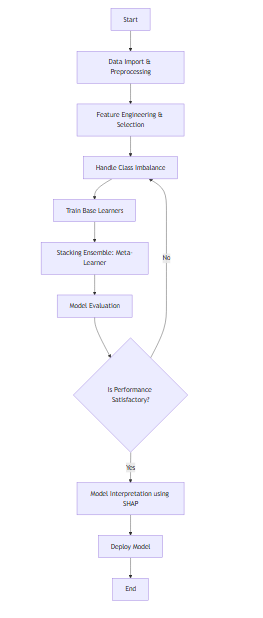
This project proposes an adaptive ensemble learning method for Network Traffic Classification to address especially in detecting attack traffic. It combines Decision Trees, Random Forests, and XGBoost with a meta-learner, supported by SHAP for model explainability. A user-friendly web interface with HTML, CSS, and JavaScript allows data upload for traffic analysis.
Abstract
Network Traffic Classification (NTC) plays a vital role in cybersecurity by enabling the identification and analysis of network data patterns. Traditional methods relying on port or payload inspection face challenges due to encryption and dynamic port usage. Machine learning techniques have emerged as effective alternatives, but they often struggle with class imbalance, where benign traffic dominates over attack data. This imbalance reduces the detection accuracy for critical minority classes such as attacks. This project addresses the class imbalance issue by proposing an adaptive ensemble learning method that combines multiple classifiers into a stacking framework. The system integrates Decision Trees, Random Forests, and XGBoost as base learners, with a meta-learner to refine final predictions. Additionally, explainable artificial intelligence techniques using SHAP are employed to enhance model transparency and trustworthiness. The proposed approach also incorporates feature engineering and data preprocessing steps to optimize performance. Evaluation metrics such as Accuracy, Precision, Recall, and F1-Score are used to assess the system’s effectiveness. Overall, this adaptive weighted ensemble improves detection of minority traffic classes, offers interpretability, and shows strong potential for scalable and robust network traffic classification in cybersecurity applications.
Keywords: Network Traffic Classification, Class Imbalance, Ensemble Learning, Stacking Classifier, Decision Tree, Random Forest, XGBoost, SHAP, Feature Engineering, Cybersecurity
NOTE: Without the concern of our team, please don't submit to the college. This Abstract varies based on student requirements.
Block Diagram
Specifications
H/W CONFIGURATION:
Processor - I3/Intel Processor
Hard Disk - 160GB
Key Board - Standard Windows Keyboard
Mouse - Two or Three Button Mouse
Monitor - SVGA
RAM - 8GB
S/W CONFIGURATION:
• Operating System : Windows 7/8/10
• Server side Script : HTML, CSS, Bootstrap & JS
• Programming Language : Python
• Libraries : Flask, Pandas, MySQL. Connector, Scikit-Learn
• IDE/Workbench : VS Code
• Technology : Python 3.8+
• Server Deployment : Xampp Server

Demo Video


Request for Video
 Paper Publishing
Request Call Back
Would you like to receive a free callback now?
Choose the best time for callback:
Leave your message and we will contact you as soon as possible

6-2-85/B, Old Maternity Hospital Road, Thyagaraja Nagar, Tirupati, Andhra Pradesh – 517501
+91 9030333433
+91 9393939065
0877-2261612

Disclaimer - Takeoff Edu Group Projects are not associated or affiliated with IEEE in any way. The IEEE Projects mentioned here are mentioned in the context of student projects, whose ideas are derived from IEEE publications, not projects of or by IEEE.

