Child Guard: A Child Safety Monitoring System
Objective
The main objective of this project is to monitor child continuously by measuring temperature, wet condition of child and crying emotion
Abstract
Preterm delivery is defined as the occurrence of birth at less than 37 weeks of the gestation period. In 2015, the World Health Organization (WHO) estimated that in 1 million among 15 million of preemies do not survive due to prematurity, making in turn preterm birth ranked as the second-leading reason for death for children who did not complete their fifth year and the number one fatal syndrome in the first month after birth.
Infants who born before 37 weeks of the gestation period are known as preterm or premature babies. Study shows that in every month of birth around 4 million infants die in the world. 25% of the deaths are cause due to complications of prematurity, most often heat and water. Vital organs or enzymes of premature babies grow to the very lesser extent and thus requires special attention to cope with external physical condition like temperature, humidity, light etc. The infant has several disadvantages in terms of thermal regulation.
An infant has a relatively large surface area, poor thermal insulation, and a small amount of mass to act as a heat sink. The new-born has little ability to conserve heat by changing posture and no ability to adjust their own clothing in a response to thermal stress. So these parameters are most important to control for saving the lives of infants. In developing country because the economy is very low so the cost of medical devices should be kept low. Thus there is a need to develop a low cost incubator which provides the facilities required for the infants. This proposed system which includes system structure, hardware circuits and software program of the incubator for premature infant. In this project we use a temperature sensor, GSR (galvanic skin response) sensor. The goal of this project is to bring a new incubator which will be cost effective with improved usability.
Keywords: GSR sensor, DHT11, moisture sensor, node MCU, buzzer, GSM, thing speak
NOTE: Without the concern of our team, please don't submit to the college. This Abstract varies based on student requirements.
Block Diagram
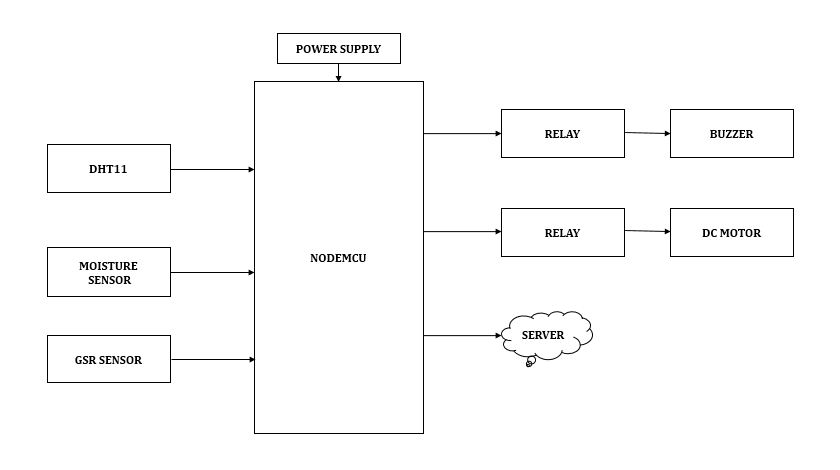
Specifications
Hardware requirements:
- NodeMCU
- Moisture sensor
- DHT11 Sensor
- GSR Sensor
- Alarm
- Relay
- Motor
- Power supply unit
Software requirements:
- Arduino IDE
- Embedded C
Learning Outcomes
- Nodemcu Pin diagram and Architecture
- How to install arduino IDE Software
- Setting up and Installation procedures for Arduino
- Introduction to Arduino IDE
- Commands in Arduino
- How to install Libraries?
- Basic coding in arduino IDE
- Working of GSR sensor
- How to interface GSR sensor with Nodemcu?
- Working of moisture sensor
- How to interface moisture sensor with Nodemcu?
- Working of DHT11 sensor
- How to interface DHT11 with Nodemcu?
- How to interface Dc motor with Nodemcu?
- How to interface nodemcu?
- How to upload data in thing speak with nodemcu?
- About Project Development Life Cycle:
- Planning and Requirement Gathering( software’s, Tools, Hardware components, etc.,)
- Schematic preparation
- Code development and debugging
- Hardware development and debugging
- Development of the Project and Output testing
- Practical exposure to:
- Hardware and software tools.
- Solution providing for real time problems,
- Working with team/ individual,
- Work on Creative ideas.
- Project development Skills
- Problem analyzing skills
- Problem solving skills
- Creativity and imaginary skills
- Programming skills
- Deployment
- Testing skills
- Debugging skills
- Project presentation skills
- Thesis writing skills


 Paper Publishing

Request Call Back
Would you like to receive a free callback now?
Choose the best time for callback:
Leave your message and we will contact you as soon as possible

6-2-85/B, Old Maternity Hospital Road, Thyagaraja Nagar, Tirupati, Andhra Pradesh – 517501
+91 9030333433
+91 9393939065
0877-2261612

Disclaimer - Takeoff Edu Group Projects are not associated or affiliated with IEEE in any way. The IEEE Projects mentioned here are mentioned in the context of student projects, whose ideas are derived from IEEE publications, not projects of or by IEEE.

