Channeling Fairness: Class Imbalance-Aware Skin Disease Recognition via Fair Channel Enhancement Module
Objective
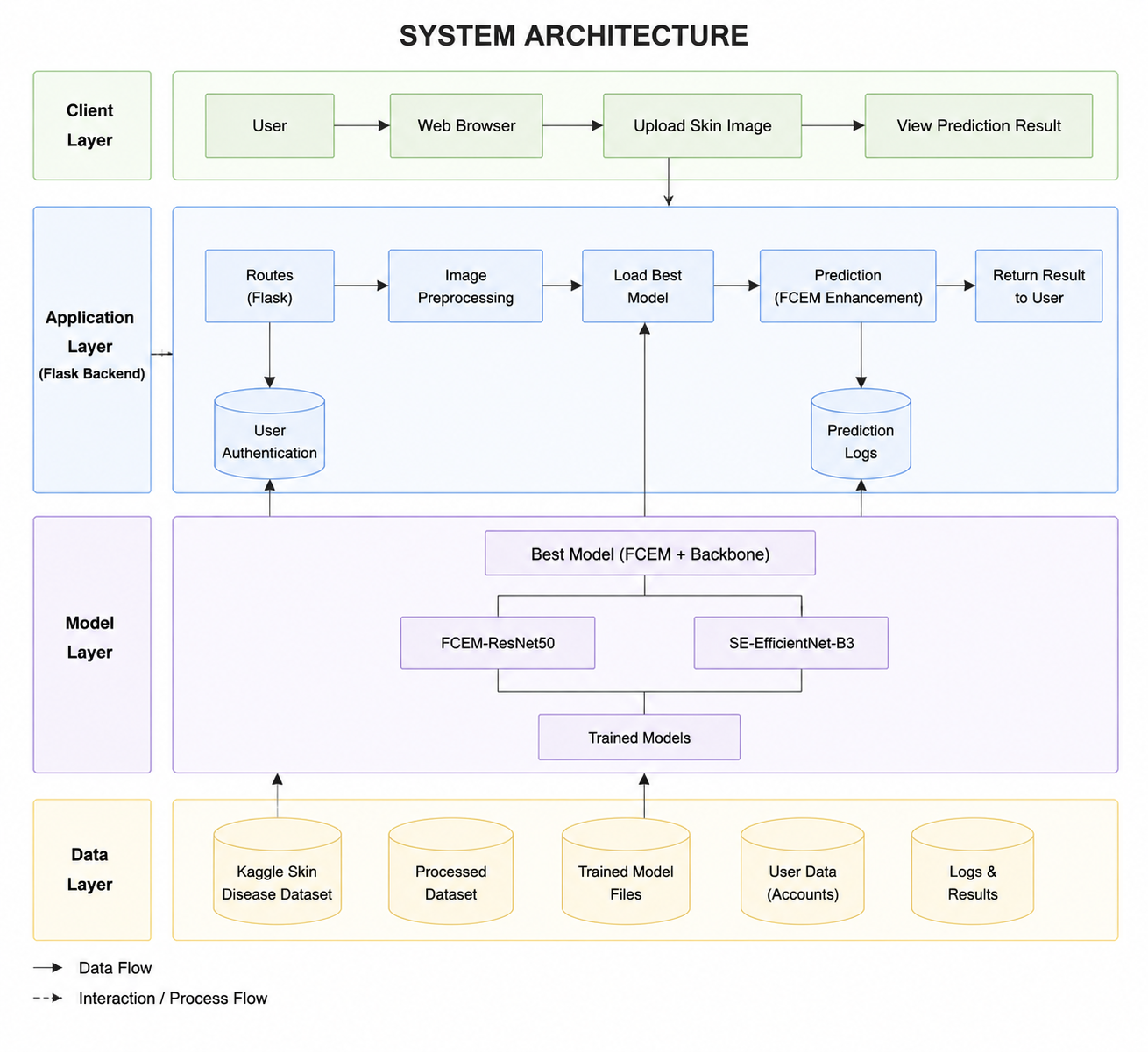
This project develops a fair skin disease classification system using ResNet50 and SE-EfficientNet-B3 with a Fair Channel Enhancement Module (FCEM) to dynamically reweight features for minority classes, addressing dataset imbalance on the Kaggle skin disease dataset. A Flask-based web interface with HTML, CSS, and JS allows user registration, login, and image submission for real-time predictions. Performance is evaluated per class using accuracy, precision, recall, and F1-score, comparing architectures to identify the most effective and fair backbone. The design emphasizes modularity, robustness, and reproducibility, enabling easy dataset expansion and future integration. Ultimately, it demonstrates fairness-aware AI for medical image classification, mitigating prediction bias across all disease categories.
Abstract
Skin diseases affect millions worldwide, yet accurate and timely diagnosis remains challenging due to the diversity of conditions and class imbalances in available datasets. This project, Channelling Fairness: Class Imbalance-Aware Skin Disease Recognition via Fair Channel Enhancement Module, proposes a deep learning framework that enhances classification performance while addressing skewed data distributions. The system integrates the Fair Channel Enhancement Module (FCEM) with ResNet50 and SE-EfficientNet-B3 architectures to extract discriminative features from skin images effectively. FCEM dynamically adjusts feature channels to improve representation of underrepresented classes, reducing bias in predictions. The web-based application, developed using HTML, CSS, JS, and Python with Flask, includes modules for user registration, login, and skin disease prediction. The model is trained on a publicly available skin disease image dataset from Kaggle, encompassing multiple disease categories. Experimental evaluations demonstrate improved accuracy, balanced sensitivity across classes, and robustness in classifying both common and rare skin conditions. This approach provides an accessible platform for researchers and practitioners to study skin disease recognition and supports the development of AI-assisted diagnostic tools. The results indicate that addressing class imbalance through channel enhancement significantly enhances model fairness and predictive reliability.
Keywords: Skin disease, Class imbalance, Deep learning, ResNet50, EfficientNet-B3, Fair Channel Enhancement, Image classification, Flask, Bias mitigation, Medical imaging
NOTE: Without the concern of our team, please don't submit to the college. This Abstract varies based on student requirements.
Block Diagram
Specifications
5.2 HARDWARE REQUIREMENTS
• Processor - I5/Intel Processor
• RAM - 8GB (min)
• Hard Disk - 160 GB
• Key Board - Standard Windows Keyboard
• Mouse - Two or Three Button Mouse
• Monitor - Any
5.3 SOFTWARE REQUIREMENS
• Operating System : Windows 7/8/10
• Server side Script : HTML, CSS, Bootstrap & JS
• Programming Language : Python
• Libraries : Flask, Pandas, Mysql. connector, Os, Numpy, Scikit- learn, sklearn, Preprocessor, tensor flow, keras, roboflow
• IDE/Workbench : VS-Code
• Technology : Python 3.10+
• Server Deployment : Xampp Server
• Database : MySQL


 Paper Publishing

Request Call Back
Would you like to receive a free callback now?
Choose the best time for callback:
Leave your message and we will contact you as soon as possible

6-2-85/B, Old Maternity Hospital Road, Thyagaraja Nagar, Tirupati, Andhra Pradesh – 517501
+91 9030333433
+91 9393939065
0877-2261612

Disclaimer - Takeoff Edu Group Projects are not associated or affiliated with IEEE in any way. The IEEE Projects mentioned here are mentioned in the context of student projects, whose ideas are derived from IEEE publications, not projects of or by IEEE.

