CERVIA: A Hybrid Deep Learning Framework With Explainable AI for Automated Cervical Cancer Classification From Pap Smear Imagesys
Objective
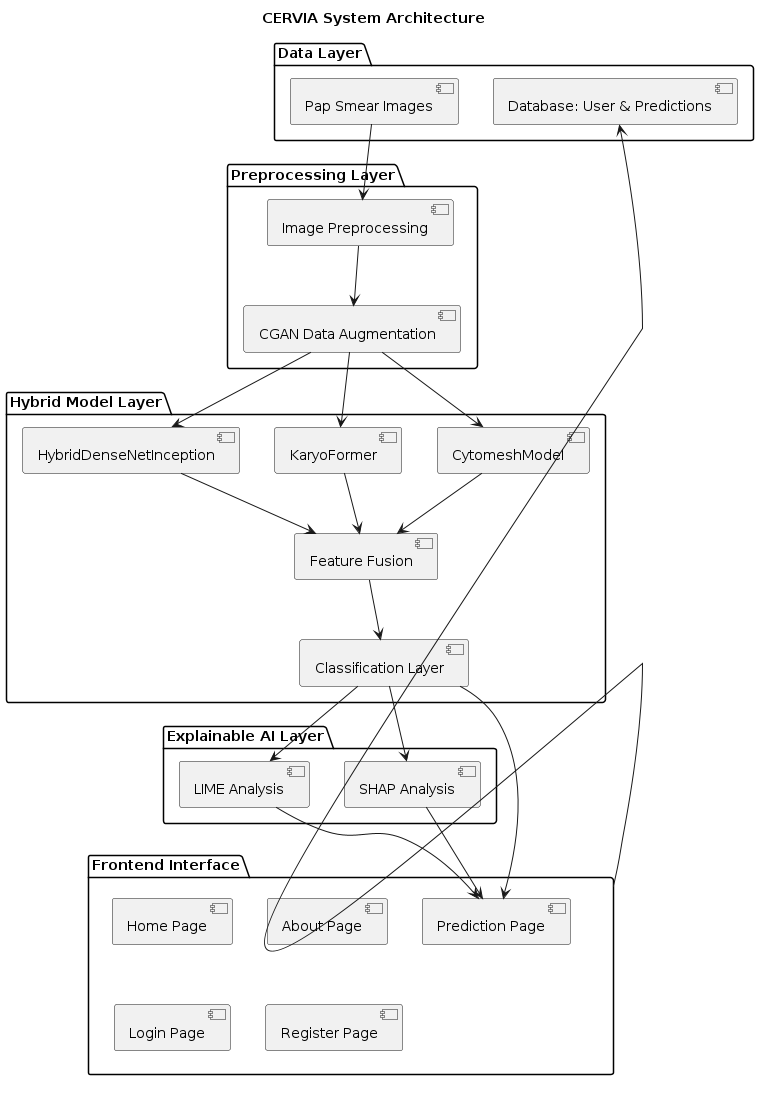
The primary objective of the CERVIA framework is to develop an automated system capable of accurately classifying cervical cells from Pap smear images into normal, precancerous, and malignant categories. To achieve this, CERVIA integrates three complementary deep learning models—HybridDenseNetInception, KaryoFormer, and CytomeshModel—enabling the extraction of multi-scale, global, and structural cellular features for enhanced classification performance. The framework also incorporates explainable AI techniques to highlight the morphological and cytological factors influencing predictions, thereby improving clinical transparency and trust. Ultimately, CERVIA aims to reduce pathologists’ workload, facilitate early detection, and ensure robust, reliable performance across diverse datasets.
Abstract
CERVIA is a novel hybrid deep learning framework
designed for automated classification of cervical cancer from Pap smear images.
Accurate detection of cervical abnormalities is critical for early diagnosis
and effective treatment, yet traditional manual examination of Pap smear slides
is labor-intensive and prone to human error. To address these challenges,
CERVIA integrates three complementary deep learning models: HybridDenseNetInception,
which captures multi-scale hierarchical features; KaryoFormer, a transformer-based
model that leverages global context and attention mechanisms; and CytomeshModel,
which models the structural relationships between cellular components. This
hybrid architecture enables the framework to exploit the unique strengths of
each model, achieving superior performance in identifying normal, precancerous,
and malignant cells. In addition, CERVIA incorporates explainable AI techniques
that highlight the morphological and cytological features influencing
classification, thereby improving interpretability and clinical trust in
automated predictions. Using the CytologCervicalCancer dataset from
Kaggle, the system demonstrates high accuracy, sensitivity, and robustness,
proving its effectiveness as a reliable tool for early cervical cancer
screening. The framework not only reduces the diagnostic workload for
pathologists but also provides transparent, interpretable results, facilitating
better clinical decision-making. Overall, CERVIA represents a significant step
forward in AI-assisted cytopathology by combining high performance with
explainable insights.
Keywords: Cervical Cancer, Pap Smear Images, Hybrid Deep Learning, Explainable AI, HybridDenseNetInception, KaryoFormer, CytomeshModel, CytologCervicalCancer, Automated Screening, Medical Image Classification.
NOTE: Without the concern of our team, please don't submit to the college. This Abstract varies based on student requirements.
Block Diagram
Specifications
4.1 SOFTWARE REQUIREMENS
Operating System : Windows 7/8/10
Server side Script : HTML, CSS & JS
Programming Language : Python
Libraries : NumPy, Pandas, Librosa, Matplotlib, Seaborn, Scikit-learn, TensorFlow, Keras, PyTorch, Torchaudio, OpenCV, SoundFile, SciPy, Joblib, Pickle, Flask, Streamlit, OS, Glob, Random, Tqdm.
IDE/Workbench : VSCode
Server Deployment : MYSQL
Database : MySQL
4.2 HARDWARE REQUIREMENTS
Processor - I3/Intel Processor
RAM - 8GB (min)
Hard Disk - 128 GB
Key Board - Standard Windows Keyboard
Mouse - Two or Three Button Mouse
Monitor - Any

Demo Video


Request for Video
 Paper Publishing
Request Call Back
Would you like to receive a free callback now?
Choose the best time for callback:
Leave your message and we will contact you as soon as possible

6-2-85/B, Old Maternity Hospital Road, Thyagaraja Nagar, Tirupati, Andhra Pradesh – 517501
+91 9030333433
+91 9393939065
0877-2261612

Disclaimer - Takeoff Edu Group Projects are not associated or affiliated with IEEE in any way. The IEEE Projects mentioned here are mentioned in the context of student projects, whose ideas are derived from IEEE publications, not projects of or by IEEE.

