Carbon Emission Prediction Through the Harmonization of Extreme Learning Machine and INFO Algorithm
Objective
Develop a predictive model for vehicle carbon emissions using ML techniques, enhancing accuracy through feature engineering and advanced algorithms.
Abstract
This project focuses on developing a predictive model for carbon emissions from vehicles using a dataset containing features such as model year, make, engine size, and fuel consumption metrics. By leveraging machine learning algorithms like Support Vector Machine (SVM), Long Short-Term Memory (LSTM), and Extreme Gradient Boosting (XGBoost), the study aims to capture complex relationships among features and enhance predictive accuracy. A key aspect of this research is the integration of the Extreme Learning Machine and Info Algorithm, which further refines the model's ability to deliver robust predictions. Additionally, the project explores feature engineering techniques and dataset augmentation to improve model performance. This study not only offers valuable insights into carbon emissions but also emphasizes the importance of leveraging diverse data sources to build comprehensive and reliable models. The findings aim to support the development of environmentally sustainable transportation policies and contribute to global climate change mitigation efforts.
Keywords: carbon emission prediction, co2 emissions, machine learning, support vector machine, LSTM , extreme gradient boosting, info algorithm, environmental sustainability.
NOTE: Without the concern of our team, please don't submit to the college. This Abstract varies based on student requirements.
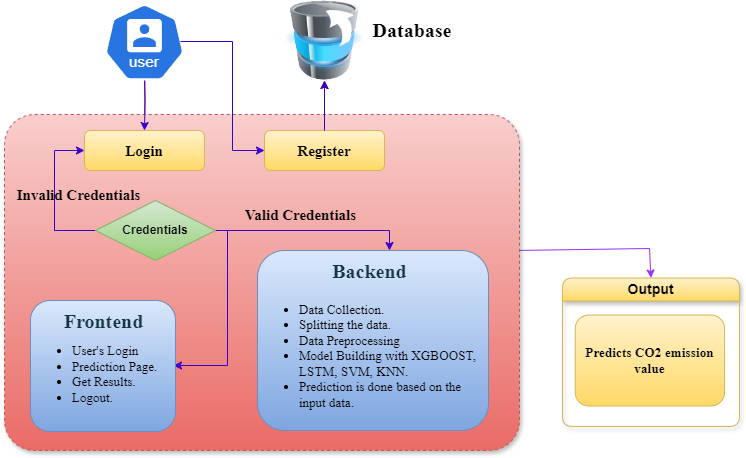
Block Diagram
Specifications
HARDWARE REQUIREMENTS
· Processor - I3/Intel Processor
· Hard Disk - 160GB
· Key Board - Standard Windows Keyboard
· Mouse - Two or Three Button Mouse
· Monitor - SVGA
· RAM - 8GB
SOFTWARE REQUIREMENTS
• Operating System : Windows 7/8/10
• Server side Script : HTML, CSS, Bootstrap & JS
• Programming Language : Python
• Libraries : Flask, Pandas, MySQL. Connector, Scikit-learn
• IDE/Workbench : VS Code
• Technology : Python 3.8+
• Server Deployment : Xampp Server

Demo Video


Request for Video
 Paper Publishing
Request Call Back
Would you like to receive a free callback now?
Choose the best time for callback:
Leave your message and we will contact you as soon as possible

6-2-85/B, Old Maternity Hospital Road, Thyagaraja Nagar, Tirupati, Andhra Pradesh – 517501
+91 9030333433
+91 9393939065
0877-2261612

Disclaimer - Takeoff Edu Group Projects are not associated or affiliated with IEEE in any way. The IEEE Projects mentioned here are mentioned in the context of student projects, whose ideas are derived from IEEE publications, not projects of or by IEEE.

