Capsule Endoscopy Classification using Inceptionv3
Objective
Develop an AI-powered Django web application utilizing a custom InceptionV3 model to classify Wireless Capsule Endoscopy (WCE) images into Normal, Ulcer, and AVM, enhancing diagnostic accuracy, reducing clinician workload, and supporting underrepresented medical datasets.
Abstract
Capsule endoscopy is a pivotal diagnostic tool for detecting small bowel abnormalities such as ulcers, arteriovenous malformations (AVM), and other gastrointestinal disorders. However, manual review of thousands of endoscopic frames is time-consuming and error-prone. This project proposes an automated classification system for Wireless Capsule Endoscopy (WCE) images using deep learning. Utilizing the KAUHC dataset curated by King Abdulaziz University Hospital, which includes 3,301 annotated images, the system classifies frames into three categories: Normal, Ulcer, and AVM. A custom-built InceptionV3 model serves as the proposed architecture, outperforming existing models such as traditional CNNs, MobileNet, and SVM classifiers. The backend is developed using Django, and a user-friendly frontend is built with HTML, CSS, and JavaScript. Users can upload endoscopic images to receive real-time diagnostic predictions. This system aims to assist gastroenterologists in enhancing diagnostic accuracy and reducing workload.
Keywords: Capsule Endoscopy, InceptionV3, Wireless Endoscopy, AVM, Ulcer Detection, CNN, MobileNet, Django, Deep Learning, KAUHC Dataset.
NOTE: Without the concern of our team, please don't submit to the college. This Abstract varies based on student requirements.
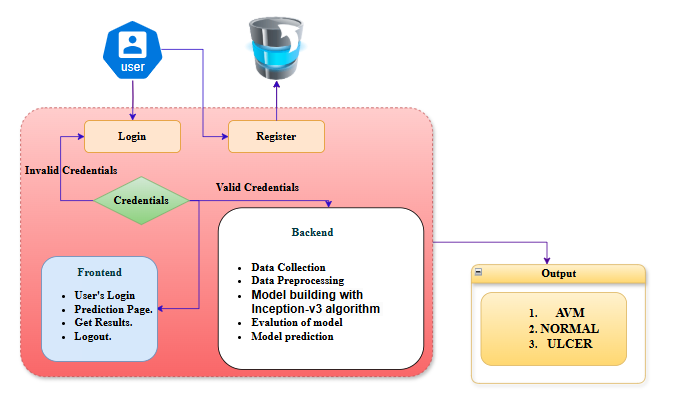
Block Diagram
Specifications
Hardware Requirements
Processor - I3/Intel Processor
Hard Disk - 160GB
Key Board - Standard Windows Keyboard
Mouse - Two or Three Button Mouse
Monitor - SVGA
RAM - 8GB
Software Requirements:
Operating System : Windows 7/8/10/11
Server side Script : HTML, CSS, Bootstrap & JS
Programming Language : Python
Libraries : Django, Pandas, Mysql.connector, Os, Smtplib, Numpy
IDE/Workbench : PyCharm or VS Code
Technology : Python 3.6+
Server Deployment : Xampp Server
Database : MySQL


 Paper Publishing

Request Call Back
Would you like to receive a free callback now?
Choose the best time for callback:
Leave your message and we will contact you as soon as possible

6-2-85/B, Old Maternity Hospital Road, Thyagaraja Nagar, Tirupati, Andhra Pradesh – 517501
+91 9030333433
+91 9393939065
0877-2261612

Disclaimer - Takeoff Edu Group Projects are not associated or affiliated with IEEE in any way. The IEEE Projects mentioned here are mentioned in the context of student projects, whose ideas are derived from IEEE publications, not projects of or by IEEE.

